


A contract example is a sample agreement you can read, copy and adapt: it shows the parties, the work, the payment, the term and the signatures in plain language. The simple services agreement below is complete, with seven clauses, and the sections after it explain what each clause does, which contract types exist and when a contract must be written down.
What does a simple contract example look like?
A simple contract example is a short agreement between two parties that names who they are, what one will do, what the other will pay and when it ends. The sample below is a services agreement in which a designer creates a logo for a coffee shop. All names and amounts are made up.
Services Agreement
This Services Agreement is made on [date] between Maple Street Design LLC, [address] (“Provider”), and Harbor Coffee Co., [address] (“Client”).
- Services. Provider will design a logo and a one-page brand guide for Client, as described in Exhibit A (the “Services”).
- Payment. Client will pay Provider $2,400 in two installments: $1,200 when this agreement is signed and $1,200 when Provider delivers the final files. Each invoice is due within 14 days.
- Term. This agreement starts on the date above and ends when the Services are delivered and paid for, or on [end date], whichever comes first.
- Ownership. After full payment, Provider assigns to Client all rights in the final logo files. Provider may show the work in its portfolio.
- Confidentiality. Each party will keep the other party’s non-public business information private during the term and for two years after it ends.
- Termination. Either party may end this agreement with 10 days’ written notice. Client will pay for all work completed up to the date of termination.
- General terms. This agreement is governed by the laws of the State of [State]. Changes must be in writing and signed by both parties. This agreement is the entire agreement between the parties.
Signed by Provider: ____________ Name, title, date
Signed by Client: ____________ Name, title, date
The sample covers the same parts that most business contracts share. If you want the layout rules behind it, our guide to contract format covers structure, numbering and page setup.
What does each clause in the sample contract do?
Each clause answers one question that could otherwise turn into a dispute: who is involved, what is delivered, what it costs, how long it lasts and how to leave. The table maps every part of the sample to its purpose.
| Part of the sample | What it says | Why it is there |
|---|---|---|
| Opening and parties | Who signs and on what date | Fixes who is bound and from when |
| 1. Services | The work and a pointer to Exhibit A | Defines what counts as finished |
| 2. Payment | $2,400 in two installments, due in 14 days | Removes doubt about amount and timing |
| 3. Term | Start date and an end tied to delivery | Gives the deal a clear finish line |
| 4. Ownership | Rights pass to the client after full payment | Settles who owns the result |
| 5. Confidentiality | Private information stays private for two years | Protects business details shared during the work |
| 6. Termination | 10 days’ written notice and payment for finished work | Gives both sides a fair exit |
| 7. General terms | Governing law, written changes, entire agreement | Stops side promises from changing the deal |
| Signature block | Name, title, date and signature for each party | Shows that each party agreed |
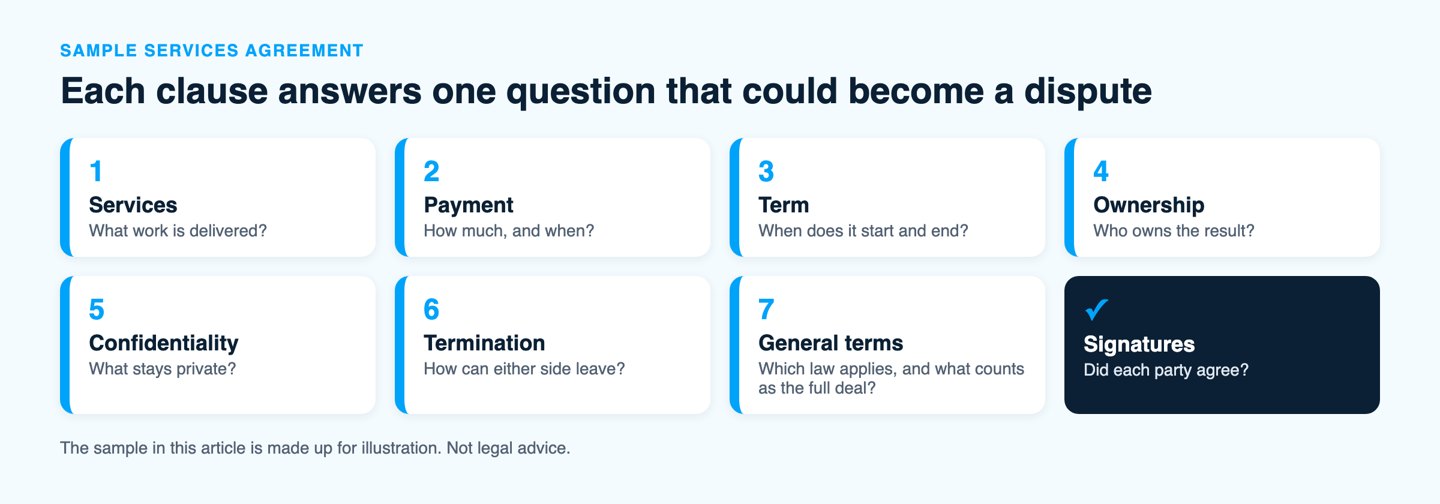
Notice that the sample uses numbers wherever it can: a dollar amount, a number of days and a number of years. Specific figures are easier to enforce than words such as “promptly” or “a reasonable fee”.
What are the most common types of contracts, with examples?
The most common contracts in small business are service agreements, independent contractor agreements, sales contracts, employment contracts, non-disclosure agreements and rental agreements. The table gives one example for each and links a free template you can download.
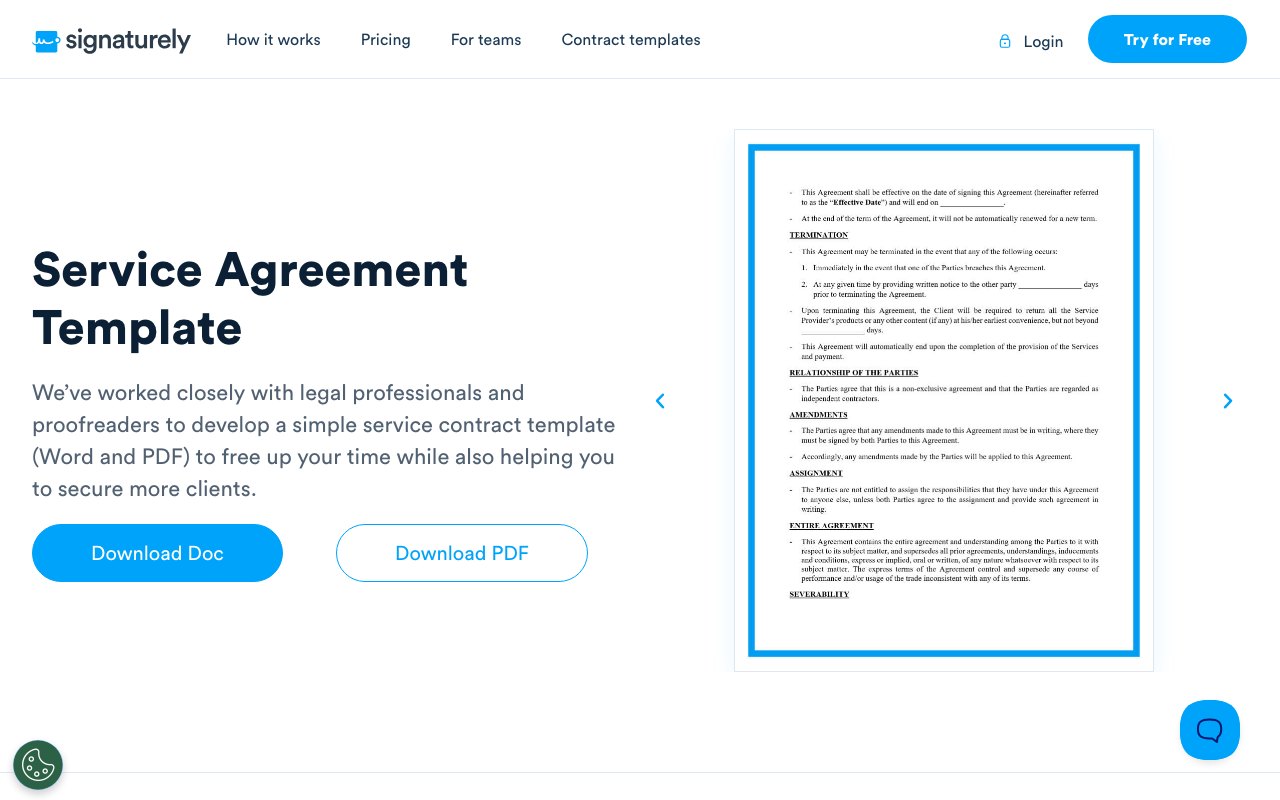
Our page of legal document examples lists many more document types if your deal does not fit one of these six.
What makes a contract example legally valid?
A contract is enforceable when it has four elements: mutual assent, which means an offer and an acceptance, consideration, capacity and legality. Cornell Law School’s Legal Information Institute describes consideration as something of value exchanged, capacity as being old enough and of sound mind, and legality as a lawful purpose.
Here is how the sample meets each one:
- Mutual assent: Provider offers the work on these terms and Client accepts by signing.
- Consideration: Provider gives a logo and brand guide and Client gives $2,400.
- Capacity: both parties are businesses that can enter agreements, and the people who sign them are adults.
- Legality: designing a logo is a lawful purpose.
A sample is only a pattern. It becomes a contract when named parties fill in the details and agree to the terms. Our guide on what makes a contract valid goes deeper on each element.
Does a contract have to be in writing?
Many contracts can be oral, but some must be in writing and signed to be enforceable under the statute of frauds. According to Cornell’s Legal Information Institute, the common categories are agreements to sell or convey real estate, agreements that cannot be performed within one year and sales of goods worth $500 or more under UCC 2-201.
The sample services agreement could be finished within a year, so the law would not force it into writing. A written contract is still the better choice, because it proves what both sides agreed. Our article on whether a verbal agreement is legally binding covers the limits of oral deals. Rules differ by state, so check your state’s law for anything high in value.
How do you turn a contract example into your own contract?
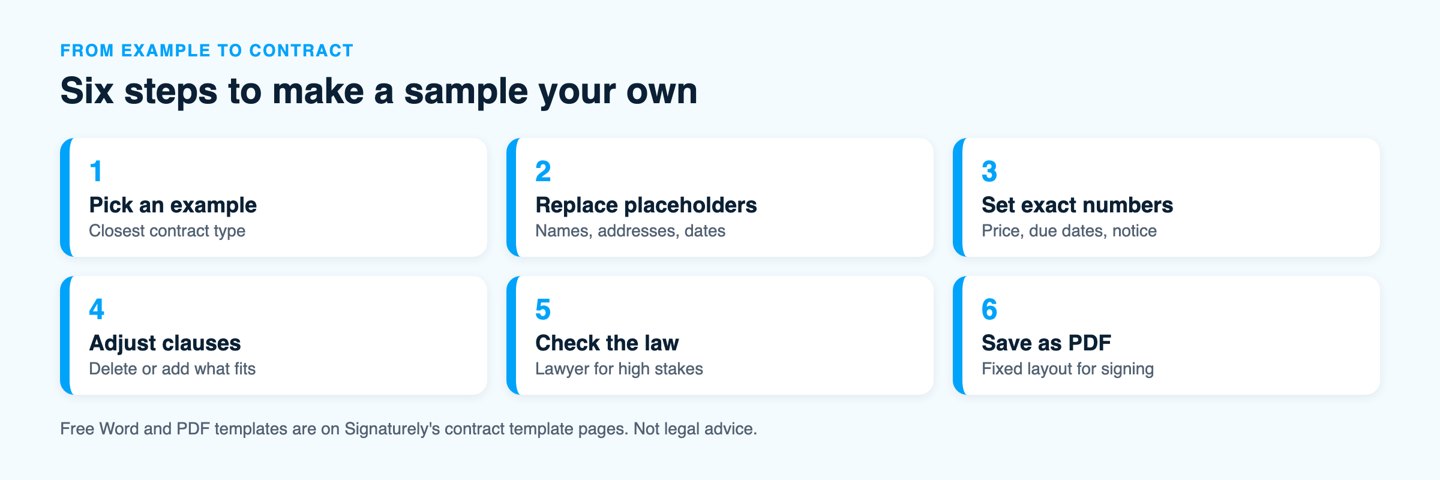
Turn an example into your own contract by picking the closest template, replacing every placeholder, setting exact figures and dates, and removing or adding clauses until it matches your deal. These steps work for any of the contract types above.
- Pick the closest example. Start from a template for your contract type so the clauses already fit.
- Replace the placeholders. Insert legal names, addresses, the effective date and any fields shown in square brackets.
- Set exact numbers. Write the price, installments, due dates and notice periods as figures.
- Adjust the clauses. Delete clauses that do not apply and add the ones your deal needs, such as a late fee or a deliverables schedule.
- Check the law. Confirm any state rules that apply, and have a lawyer review contracts of high value or high risk.
- Save the final version. Save it as a PDF so the layout stays fixed when you send it for signature.
Our guide on how to write a contract explains the drafting side in more detail, including how to word each clause.
How do you sign a contract example electronically?
Sign a contract electronically by uploading the finished PDF to an e-signature tool, placing signature fields for each party and sending it. Under the federal E-SIGN Act, a signature, contract or other record in interstate or foreign commerce may not be denied legal effect, validity or enforceability solely because it is in electronic form.
With Signaturely the steps are short:
- Upload your Word or PDF contract.
- Add signature, date and text fields for each signer.
- Send the document and let each signer sign from any device.
- Download the signed contract, which comes with an audit log of who signed and when.
Our guides on how to sign a contract online and the E-SIGN Act cover the process and the law in more depth.
Signaturely has a free plan with 1 document a month after the 7-day trial. Personal costs $20 a month billed annually ($25 billed monthly, or $240 a year) for 5 signature requests a month, and Business costs $40 per user a month billed annually ($50 billed monthly, or $480 a year per user) with unlimited signature requests. Both paid plans include an audit log, reminders and integrations with Google Drive, Dropbox, OneDrive and Box. Prices checked on the Signaturely pricing page in November 2026.
Frequently asked questions
The sample above is one: a designer agrees to create a logo and a coffee shop agrees to pay $2,400 for it, with both promises written down and signed.
A simple contract should include the legal names of the parties, a description of the work or goods, the price and payment dates, the start date and length, how either side can end it and a signature block for each party. The sample above adds confidentiality, ownership and general terms.
A sample on its own binds no one, because it names no real parties. It becomes a binding contract when named parties complete the details and agree, and the agreement has mutual assent, consideration, capacity and a lawful purpose.
Many contracts can be oral, but the statute of frauds requires a signed writing for some, such as real estate sales, agreements that cannot be performed within a year and sales of goods worth $500 or more. A written contract is easier to prove in any case.
A contract can be signed online. The E-SIGN Act says a signature or contract may not be denied legal effect solely because it is in electronic form, so an e-signed PDF carries the same weight as a printed one in most cases.
A lawyer is not required for a simple, low-risk deal, but is worth hiring for contracts of high value, long duration or unusual risk. A template saves drafting time, and a lawyer can check that it fits your state and your situation.