



A legal document is a written record that creates, changes or proves legal rights and duties, such as a contract, a lease, a loan agreement or a power of attorney. Below are 19 free legal document examples you can open as templates, fill in and sign online, followed by what makes a document legally binding and how to prepare one.
What is a legal document?
A legal document is any written record that sets out rights, duties or facts in a way the law recognizes. Agreements between parties, such as contracts, leases and loans, are the most common kind. Others record one person’s decision or statement, such as a will, a power of attorney or an affidavit.
Most legal documents share the same core parts: the full names of everyone involved, a clear statement of purpose, the terms each side agrees to, the date and a space for each party’s signature.
What are the types of legal documents?
The main types of legal documents are business contracts, employment agreements, real estate agreements, money agreements, rights and permission forms, and personal and court documents. The table groups the 19 examples below by type and links each free template.
For a worked sample with every clause explained, see our contract example. For layout and numbering, see our guide to contract format.
19 Legal Document Examples With Templates
These sample legal document templates from Signaturely are free to use and fully editable. Pick the one you need, fill in the blanks and send it for signature. Each entry links to the template page, where you can download it.
Non-Disclosure Agreement Example
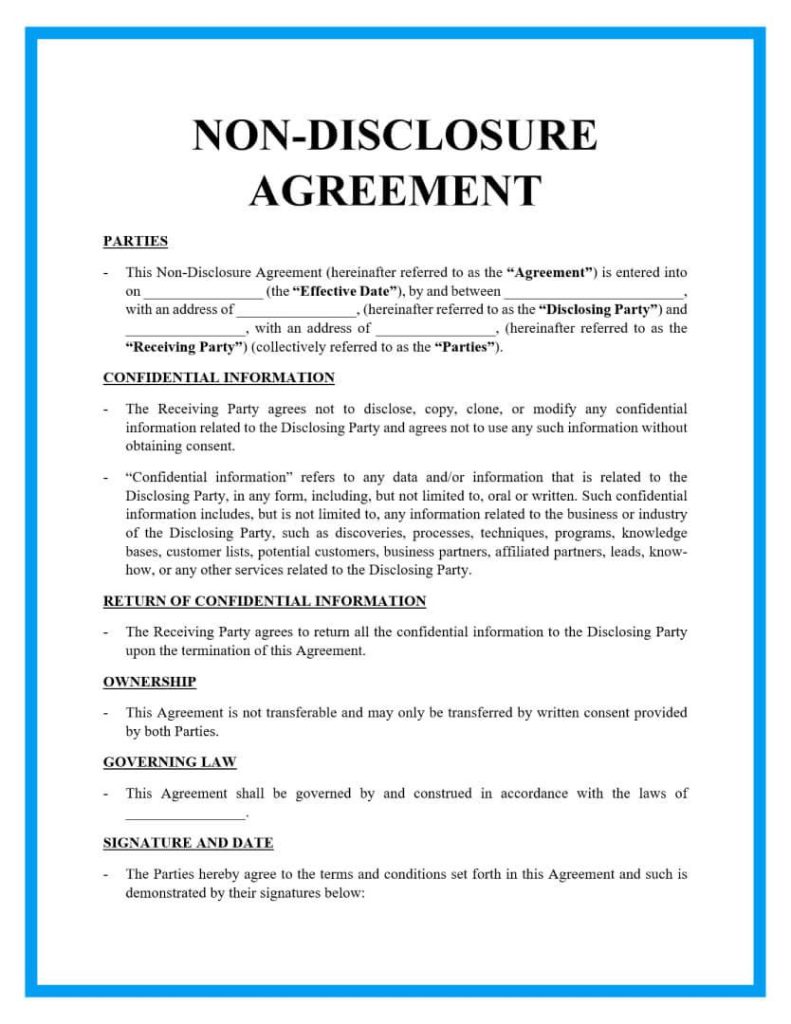
This NDA template enables you to protect your data while sharing it with other parties. This is useful anytime you need to protect your intellectual property. This legal contract example allows you to legally bind and prevent other parties from sharing disclosed sensitive information.
As a confidentiality agreement, NDAs are used across multiple industries. They are often included with an employment contract for each new hire to prevent employees from leaking data to unrelated parties.
Work for Hire Agreement Example

This straight-forward work-for-hire agreement is a useful legal document for any work you’re receiving or providing. This agreement lists the provided services and their prices.
This simple yet elegant business contract is perfect when you need a purchase agreement for two or more parties to agree on services and their cost before these services are provided.
Referral Agreement Example

This referral agreement template enables you to pay a commission to a third party every time they generate a sale for your business. For example, if you run a referral program with tools like ReferralCandy, this agreement sample is ideal.
With this contract, you can agree to pay a percentage or fixed commission to another party while specifying that they are not directly working for your company.
Property Management Agreement Example

With this property management agreement, you can quickly set up the exclusive rights of a piece of property, its entrusted agent, and the payment terms between the parties.
Real estate agents can use this legal document to manage properties and sell/rent them on behalf of their owners while specifying the fee the agent will collect in return. The contract can also empower the agent to solve disputes with tenants, inspect and maintain the property, find and screen potential tenants and buyers, and advertise the property for sale or rental.
Agency Agreement Example
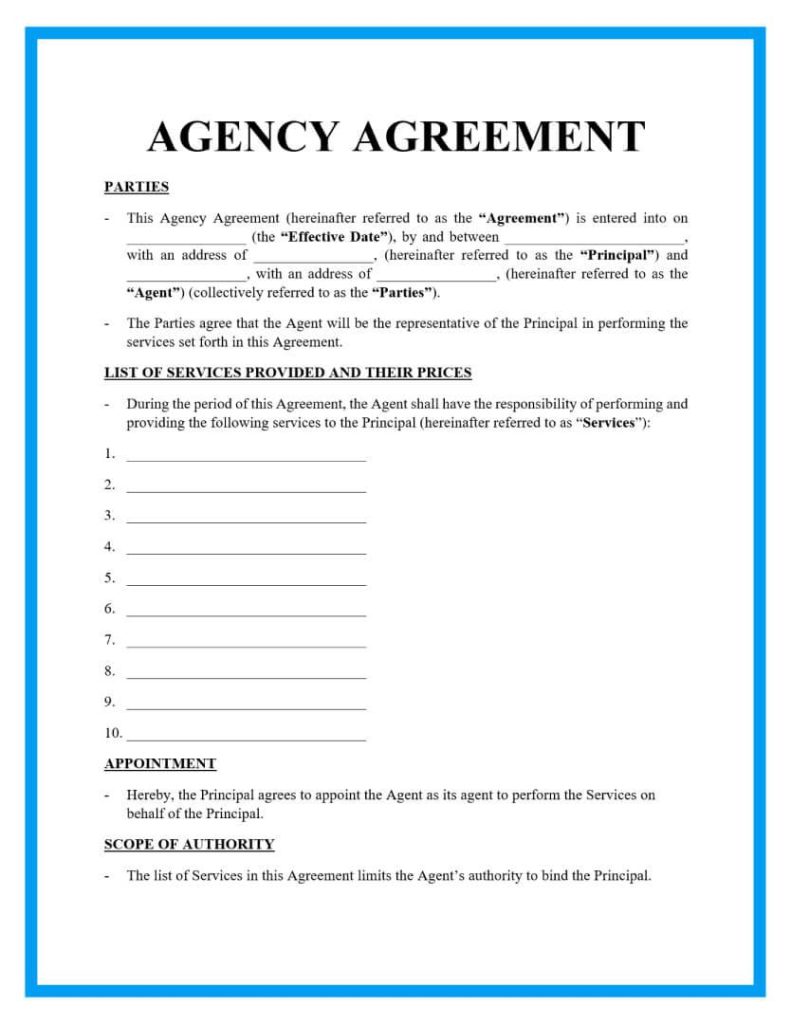
This simple agency agreement template is one of the most versatile legal documents that an agency can use.
With this template, an individual or business entity can authorize another individual or entity to act on their behalf. This individual or entity can manage contracts, sell properties, and/or provide legal representation.
Payment Agreement Example
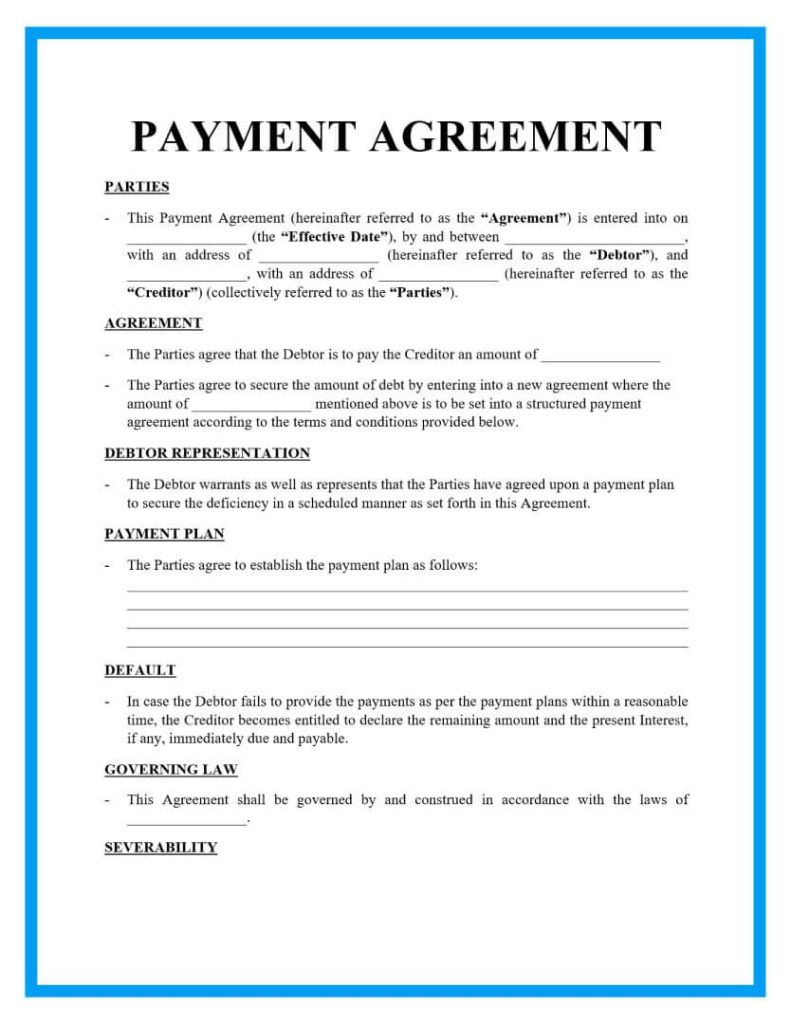
This precise payment agreement positions you to set up a legal contract where one party agrees to pay another a specific, one-time payment.
Like a legalized I.O.U., this payment agreement allows you to break down the payment into installments and agree on how and when the payment will be collected.
If you do not have a written payment agreement, it is much harder to prove the terms and take legal action if your debtor fails to make their repayments resulting in a bad debt expense.
Non-Compete Agreement Example

Through this non-compete agreement, an employer can hire an employee and prevent them from using their acquired knowledge and experience to join or otherwise aid the competition.
With the protection of this legal agreement, a business owner can train new employees and show them company secrets to improve their skills while avoiding the risk of employees using those secrets to work against the business.
Enforceability of non-compete agreements depends on state law and the courts, which judge whether the restriction is reasonable; some states, such as California, void most employee non-competes. The FTC’s nationwide ban on new non-competes is not in effect after a federal court blocked it in August 2024, so check your state’s rules before you use one (FTC Noncompete Rule page).
Memorandum of Understanding Example

This memorandum of understanding template permits two or more parties to agree on their role and intent in a negotiation.
An M. O. U. helps when multiple parties want to agree on a common line of action. The agreement describes the line of action and what roles each party will play in it.
Loan Agreement Example

The loan agreement is one of the most common legal documents. These agreements allow you to establish simple loan terms. The borrower agrees in writing to how they will repay said loan.
This template also provides space for payment breakdowns, late fees, etc. You can detail exactly how much money one party is lending to another and how that money will be repaid.
Intellectual Property Agreement Example

This intellectual property agreement template is designed to protect an organization’s inventions.
With this template, you can outline employees’ inventions for a company and detail how these new discoveries and breakthroughs will be integrated into the business’s IP rights.
Employment Contract Agreement Example

With this employment contract agreement, you can hire the talent you need and share their responsibilities as employees and their employee compensation. The agreement also details any working benefits and lists the potential reasons for instant employee termination.
This comprehensive contract is one of your repertoire’s most vital legal document templates.
Rental Agreement Example

You can fill out this rental agreement template, a clear lease agreement example, with information from the tenant, the landlord, and the rental property.
This template works as both a personal and commercial lease agreement. You can detail how and when the rent will be paid, the length of the property rental, and all termination details. The language is all written in simple, plain terms so that all parties can easily understand the clauses.
Sublease Agreement Example

This sublease agreement enables tenants to sublet their rental property to a third party.
The document lists which parts of the property will be rented, for what duration, and the amount of rent. Remember that these contracts are only enforceable if the original tenant’s contract allows for subletting of the property.
Sales Contract Example

This sales agreement template helps you determine the terms and conditions between buyer and seller for acquiring a good or service.
Even though these agreements are not required for every transaction, sales agreements are useful legal documents when making a substantial or long-lasting purchase agreement or when purchase records are needed.
For businesses operating online, having properly structured terms and conditions within the contract is important. Termly’s Terms & Conditions Generator, for example, makes it easy to create customizable, legally structured terms tailored to your business model and jurisdiction, helping you implement clear rules for users.
Retainer Agreement Example
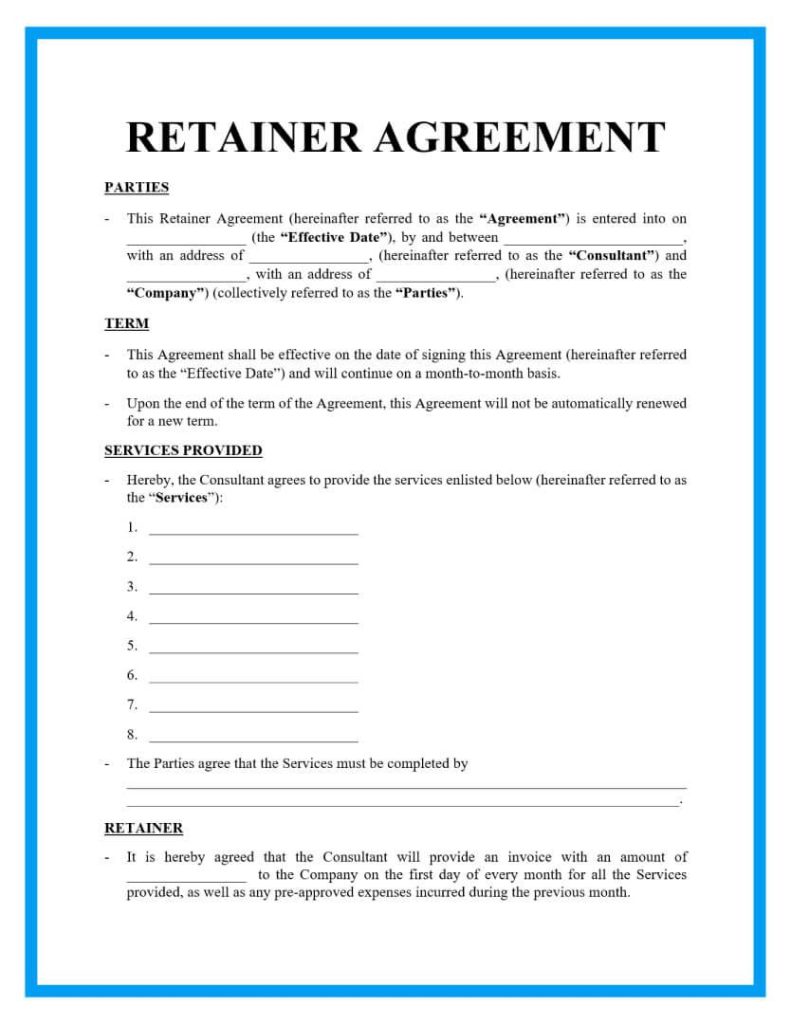
This free retainer agreement template empowers you to have any professional on standby for your business.
The template includes spaces to add the amount and frequency of the retainer fee, the services that the party will provide, and terms for extra reimbursements. It has all you need to collaborate with the professionals or companies your business needs to prosper.
Independent Contractor Agreement Example

With this independent contractor agreement template, also serving as a freelance contract example, you can expediently hire third-party contractors and verify their specific jobs and associated rates.
Working with independent contractors relieves you from hiring teams of experts or managing different departments. This agreement also clarifies independent contractors’ tasks and sets the terms and conditions for fulfilling the contract and rendering payment. It holds all involved parties accountable.
Commission Agreement Example

This commission agreement template establishes a clear commission system for individuals or businesses based on how much income they generate for a business.
The template includes everything necessary to describe and enforce the commission structure and amount and the terms both parties must abide by to validate the contract.
Service Agreement Example

This service agreement template lists provided services along with their associated rates. It also stipulates a payment schedule and terms for contract termination.
The document records the agreed services and payment terms, so both sides can refer back to it if a dispute comes up. It does not replace an invoice.
Video Release Form Example

Commonly used by filmmakers and video production houses, video release forms allow anyone to quickly grant their permission to appear on camera for commercial purposes.
This legal document is vital for anyone posting recordings in public spaces. Release forms make it easy for videographers to obtain and maintain the rights to their footage while ensuring that the film does not violate anyone’s privacy.
What makes a legal document legally binding?
A legal document is binding when it meets the basic elements of an enforceable contract: mutual assent (an offer and an acceptance), consideration (something of value is exchanged), capacity (such as minimum age and sound mind) and legality (a lawful purpose), according to Cornell Law School’s Legal Information Institute. In some states, a valid substitute can satisfy the consideration element.
- Offer and acceptance. One party proposes terms and the other agrees to them.
- Consideration. Each side gives or promises something, such as money for work.
- Capacity. Each party is old enough and mentally able to understand the deal.
- Legality. The purpose of the agreement is lawful.
A signature is not one of the four elements, but it is the usual proof that each party agreed. Under the federal E-SIGN Act, a signature or contract can’t be denied legal effect, validity or enforceability solely because it is in electronic form, so a document signed online counts the same as one signed on paper. The Act has exceptions: it does not apply to wills, codicils and testamentary trusts, to adoption, divorce and other family law matters, to court orders and official court documents or to most of the Uniform Commercial Code, and it also leaves out certain notices such as utility shutoffs and default, foreclosure or eviction notices on a primary residence (15 U.S.C. 7003). Our guide to the E-SIGN Act explains the rule in more depth.
How to prepare and sign a legal document
To prepare a legal document, start from a template that matches your deal, fill in every detail, check your state’s rules and have each party sign. A template saves time because the structure and standard clauses are already there.
- Pick the right template. Match the template to the deal, such as a rental agreement for a lease or an independent contractor agreement for a freelancer.
- Fill in every detail. Add the full legal names, addresses, dates, amounts and deadlines. Remove or replace any placeholder text.
- Check your state’s rules. Laws differ by state, and some rules, such as those on non-competes, change over time. Confirm that the template is current and fits where you live.
- Get a lawyer to review high-stakes documents. You can write a document from scratch, but for complex business agreements, large sums or long-term partnerships, ask a lawyer to review it.
- Sign and keep copies. You can meet in person or mail a paper copy, or you can digitize the document so all parties can sign from any device. Every party should keep a signed copy.
Online signing saves the most time. Upload your document to a platform like Signaturely (or start from one of our templates), set up signature fields, and add the business email of each signer. You can set the order in which signers receive the document. With Signaturely, signers get an invitation that walks them from creating their legal signature to the last signature field. Signaturely has a free plan with 1 document a month after the 7-day trial; prices are on the pricing page.
Why are legal documents important?
Legal documents set out the terms in writing, so every party knows what was agreed. They let you establish and enforce an agreement without a long negotiation, and each party keeps its own copy to show a lawyer if a question comes up. They are used everywhere, from a joint venture agreement between two companies to a prenuptial agreement between two people.
Frequently asked questions
Final thoughts on legal document examples
Pick the template that matches your deal, fill in every detail and check your state’s rules before anyone signs. All 19 templates are listed on our free contract templates page, and you can send the finished file with a signature request from Signaturely.
A legal document should state its purpose, the full names of all parties, the key facts such as dates, addresses and amounts, and a space for each party’s signature. Depending on the document and the location, there may be one or several signing areas.
A template on its own binds no one. It becomes a binding document when named parties complete it and agree to it, and the agreement has mutual assent, consideration, capacity and a lawful purpose. State law can add requirements, so check yours.
Not necessarily. A written agreement is legally binding only when it shows an offer and acceptance, consideration, capacity and a lawful purpose. A signature is the usual proof that each party agreed.
Yes for most documents. Federal law says a signature or contract can’t be denied legal effect solely because it is electronic, but wills, family law matters, court documents and certain notices are excluded.
Not for every simple agreement, but a lawyer’s review is worth it for large sums, real estate, employment terms or anything else where a mistake would be costly. A lawyer can also tell you what your state requires.
The 19 legal document templates in this guide are free to use: open a template page, fill in the details and send it for signature. For wills, powers of attorney and other personal documents, use your state’s official forms.
Yes. Each Signaturely contract template page has a Download Doc and a Download PDF button, so you can edit the document in Word or print the PDF.
Legal document examples are pre-drafted templates or sample documents that illustrate common agreements such as leases, NDAs and employment contracts. You can customize them to fit your situation.
Open the rental agreement entry above, or go straight to the rental agreement template page and use its Download Doc or Download PDF button.
Three legal documents every adult should consider are a will, a power of attorney and a living will. A will states who inherits your property. A living will records your wishes if you cannot decide about your own care. These follow state rules, so use your state’s forms.
A power of attorney form is a legal document that lets another person act for you on financial or health care matters when you cannot. It should state the scope of that authority and when it ends.
An affidavit sample is a template for a written statement of facts that the signer swears or affirms under oath to be true. Use your state’s form, because courts often set their own requirements.