



A wet signature is a mark made with a pen on a physical document. It’s the legally binding original that courts, banks, notary publics and government agencies require for notarized documents, wills and certain legal filings where an electronic or digital signature won’t do. There’s no substitute. To add one to a PDF, print it out, sign it by hand and scan it back to digital format. Or use an e-signature app to draw or upload your signature instead.
What Is a Wet Signature?

A wet signature is a physical, handwritten mark made with a pen on paper. It’s the form required for notarized documents, wills, mortgage papers, court filings and any document where authenticity has to be verifiable in person. You’ll see it called a wet ink signature, an original signature or a handwritten signature; all mean the same thing.
The “wet” in the name refers to how long it takes for ink to dry. That’s the whole etymology. Courts, banks and government agencies treat it as the legal original because it was made in person, by hand, with a writing instrument: a pen, a stamp or even a thumbprint.
Wet Signature vs Electronic Signature vs Digital Signature
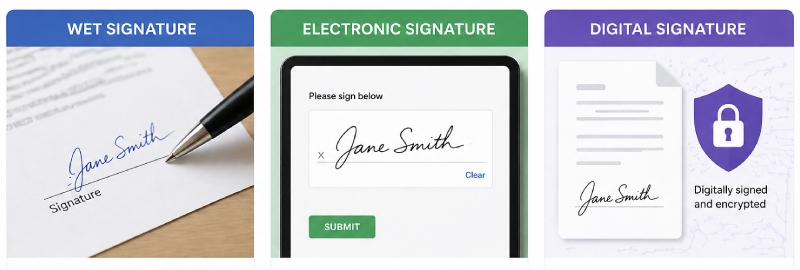
Wet signatures are physical signatures: ink on paper, made by hand. Electronic signatures are digital representations of consent: a typed name, a drawn mark or a scanned image. Digital signatures go further. They attach a digital certificate from a Certificate Authority to the document, a security feature that handles identity verification and flags any tampering after the file leaves the signer’s hands. That’s what separates the three signature types.
The Electronic Signatures in Global and National Commerce Act (ESIGN, 2000) gives electronic and digital signatures the same legal weight as wet signatures for most contracts. So does the Uniform Electronic Transactions Act, adopted by 49 states, D.C., Puerto Rico and the US Virgin Islands. New York didn’t adopt UETA but has its own equivalent law. Every digital signature’s also an electronic signature. Not every electronic signature is digital.
| Type | How it works | Legal standing | Identity check |
|---|---|---|---|
| Wet signature | Ink on paper, made by hand | Universally accepted | None built in. Relies on handwriting comparison or witnesses. |
| Electronic signature | A digital mark: typed name, drawn signature or scanned image | Equal to wet for most contracts under the ESIGN Act | Varies by platform; basic to none on simple e-sign tools |
| Digital signature | Electronic mark plus a cryptographic certificate from a Certificate Authority | Equal to wet; highest security standard | Certificate Authority verifies signer identity and document integrity |
When Is a Wet Signature Required?
Wills, trusts, powers of attorney, real estate deeds, official documents like notarized forms, court filings, adoption papers and most immigration forms still call for a traditional wet signature. Many contracts also require parties to use one even when they’ve got e-signature tools available. The ESIGN Act doesn’t cover these document categories under its electronic-signature protections.
- Wills and testamentary trusts: Section 103 of the ESIGN Act carves these out by name, and most states need two witnesses to be present at signing in person. Six states allow electronic wills, but that’s not the norm. Nevada, Florida, Indiana, Arizona, Utah and Colorado are the exceptions.
- Powers of attorney: it’s a grant of significant legal authority over finances or healthcare, so courts and institutions require ink to guard against fraud.
- Real estate deeds and mortgage documents: most title companies and county recording offices won’t accept a deed for filing without an original wet signature. FDIC guidelines for financial institutions also require ink signatures on certain bank lending documents.
- Notarized documents: notarization calls for the signatory to appear in person before a notary public. The signature has to be ink on paper.
- Court orders and legal filings: most federal courts accept electronic filing, but many state and local courts haven’t moved to electronic signatures on pleadings and sworn affidavits.
- Adoption and family law documents: adoption papers, divorce decrees and related forms fall under the ESIGN Act’s family-law exclusion.
- Immigration forms: many USCIS forms mandate original wet-ink signatures, and some forms reject e-signatures outright. The acceptance varies enough by form type that it’s worth checking the specific instructions before you sign. Rules vary.
How to Add a Wet Signature to a PDF
Three ways to get a wet signature onto a PDF: print, sign and scan the document; scan your signature as an image and insert it; or draw or upload your signature in an e-signature app like Signaturely. Each method suits a different situation.
Method 1: Print, Sign and Scan
This traditional method is the only one that produces a true wet signature: ink on paper, in your hand, on the actual printed document. Use it. It’s the right choice when the other party needs an original signed form, not a digital version.
- Download and print the PDF.
- Sign with a pen.
- Scan the signed document. Any mobile device with a decent camera works; Adobe Scan and Genius Scan are the go-to apps if you don’t have a dedicated scanner.
- Save the scanned document as a PDF.
- Email or upload the signed file to the recipient.
Method 2: Scan Your Signature as an Image and Insert It
Sign a blank sheet once, scan it and save it as a PNG you can drop into any PDF you need to sign, so there’s no reprinting the full document each time you’re asked for a signature. Faster by far.
- Sign your name on a blank white sheet using a dark pen. Make the signature as large as it fits on the page; a bigger image scans cleaner and drops into the signature field without pixelation.
- Scan the signature and save it as a PNG image file. A transparent background makes placement cleaner, so check whether your scanning app offers it as an export option.
- Open the PDF document in Adobe Acrobat, select Fill & Sign, choose to insert an image and place the PNG in the signature field.
- Resize and position the signature, then save the file.
Method 3: Draw or Upload Your Signature with Signaturely
Signaturely is a free PDF signer that runs in the browser. No download needed. The free plan covers one signature request per month, and you’re free to draw your signature or upload the PNG from Method 2.
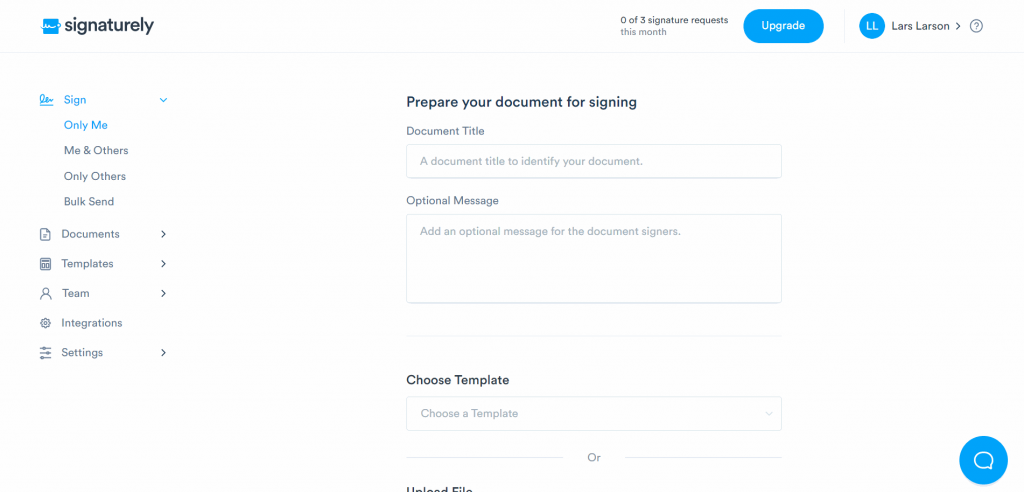
- Log in at signaturely.com and click Sign. Select the number of signers for the document.

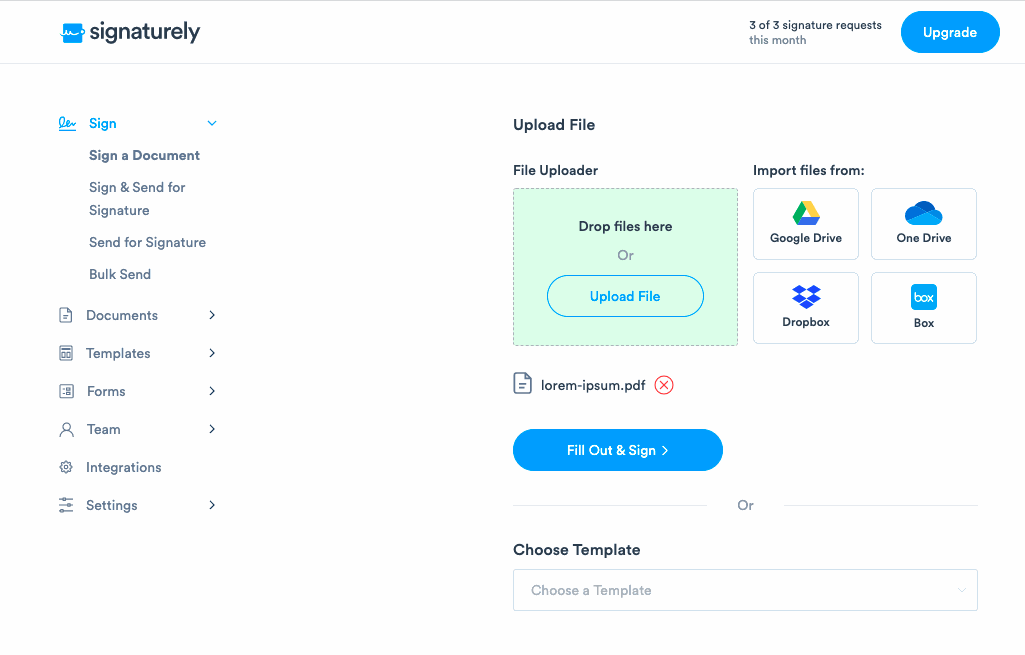
- Upload your PDF using the Upload File button or drag it into the drop zone. You can also pull the file from Google Drive, Dropbox or Box.
- Click Fill Out and Sign, then click the signature field in the document.
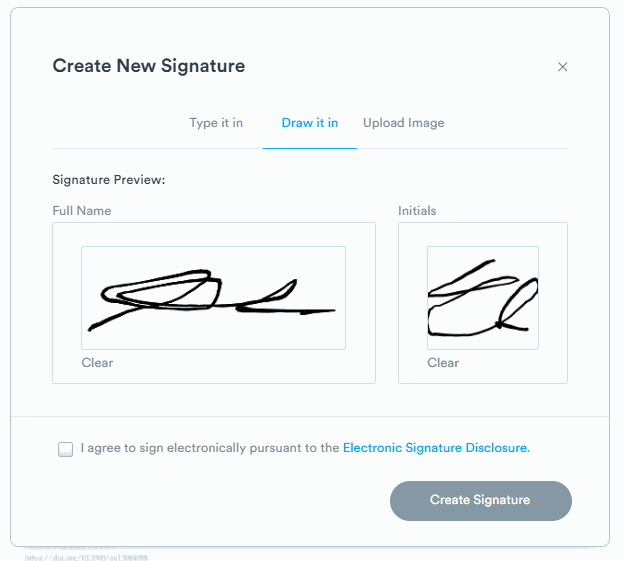
- The pop-up gives two options: Draw It In (sign with a mouse or stylus) or Upload Image (use a PNG you already have). Click Create Signature when you’re satisfied with the result.

- Place the signature in the correct field, then click Send. A signed copy arrives in your inbox.
Pros and Cons of Wet Signatures
Wet signatures are flat-out required for specific legal document categories, and they’re hard to repudiate. While the format’s legally unassailable, the real cost is operational. Routing a paper document through the signing process can take days or weeks, and there’s no automated tracking when it gets delayed.
| Pros | Cons |
|---|---|
| Forensic verifiability: handwriting experts can analyze pressure, stroke pattern and ink distribution to verify authenticity | Slow: routing signed paper between parties takes days or weeks |
| Technology independence: sign anywhere with just a pen, no app or internet required | Higher cost: paper, printing, courier services and physical storage all add up |
| Required for high-stakes legal documents: non-negotiable for wills, notarized docs and most real estate deeds | No automated audit trail: unlike e-signatures, there’s no built-in timestamp or access log |
| Psychological commitment: writing a signature by hand activates stronger intention signals than clicking a button | Forgery vulnerability: wet signatures are easier to copy than digital signatures secured by a Certificate Authority |
| Environmental cost: paper and courier shipping have a higher footprint than digital alternatives |
Frequently Asked Questions
No, any legible handwritten mark counts as a wet signature. Courts and banks care about intent and identity, not penmanship. You can print your name, use initials or sign in any style you prefer.
Most courts and institutions accept a scanned wet signature. If someone might challenge authenticity later (for a will, a real estate deed or a notarized form), keep the original signed paper. A scan’s a copy, and the original has unique physical characteristics a copy can’t replicate.
A wet signature is ink on paper. A digital signature is an electronic mark secured by a cryptographic certificate from a Certificate Authority. That certificate verifies the signer’s identity and confirms no one altered the document after signing. A wet signature’s built-in verification is zero: authenticity relies on handwriting analysis or witnesses instead.
Sign a blank sheet of paper with a pen, scan it and save the image as a PNG. Open the PDF in Adobe Acrobat, select Fill & Sign, choose to insert an image and place the PNG in the signature field. Resize as needed and save the file.
Ink signature, original signature, manual signature and handwritten signature are all professional alternatives. You’ll find “original handwritten signature” in business and legal documents when the drafter needs to make clear that ink is required rather than an e-signature.