



SignNow is capable e signature software. Most teams run into the same problems, though: support’s slower than most competitors, the interface feels cluttered and there’s no permanent free plan. If you need transparent pricing, a stronger mobile experience or enterprise grade compliance for regulated industries, these 10 alternatives are worth evaluating.
The table below gives you a quick side-by-side view before diving into each tool.
| Tool | Best for | Free plan | Starting price |
|---|---|---|---|
| Signaturely | Unlimited signing at a transparent price | Yes (1 doc/mo) | $20/mo |
| DocuSign | Enterprise compliance | No (free trial) | $10/mo |
| Adobe Acrobat Sign | Adobe ecosystem users | No (free trial) | $13/user/mo |
| PandaDoc | Sales teams and document automation | Yes | $19/user/mo |
| Dropbox Sign | Simple signing with Dropbox integration | No (30-day trial) | $15/user/mo |
| Zoho Sign | Zoho platform users | Yes | $10/mo |
| Signeasy | Mobile-first teams | No (free trial) | $10/user/mo |
| Xodo Sign | PDF editing and signing at a low price | Yes (3 docs/mo) | $10/mo |
| DigiSigner | Real estate and small businesses | Yes (limited) | $25/mo |
| SignRequest | GDPR-focused small teams | Yes | $9/user/mo |
Top 10 SignNow Alternatives in 2026
Each listing covers who the tool is best suited for, its core features, known limitations and current pricing. No pricing-page rabbit holes.
1. Signaturely
Best for: Small to mid-sized teams wanting unlimited signatures at a transparent price.
Signaturely makes it easy to upload documents and request signatures from any device. Transparent pricing and no hidden fees separate it from SignNow. Customer support’s faster too. Both platforms let you create templates and set automated reminders, but SignNow includes an ADP integration that Signaturely doesn’t.
- Audit log and full signature history
- Automated reminders and customizable templates
- Team management with role permissions and custom branding
- Integrations with Google Drive, Dropbox, OneDrive and Box
Limitations:
- Personal plan capped at 5 signature requests per month
- No in-person signing option
Pricing: Free plan covers 1 document per month. Personal starts at $20/mo billed annually; Business at $40/user/mo billed annually.
2. DocuSign
Best for: Large enterprises needing the highest compliance certifications in the market.
DocuSign is the industry leader in enterprise grade compliance. It’s HIPAA and FedRAMP certified. It covers more platforms than any other tool on this list, with customizable workflows across Salesforce, Google Drive and Microsoft 365. SignNow’s unlimited templates at a lower base price suit teams that don’t need that depth. For enterprise clients in healthcare, finance or government, DocuSign’s the clear choice: strong security, legal compliance and the largest integration ecosystem in the category.
- HIPAA and FedRAMP certified for regulated industries
- Customizable workflows with conditional routing
- Integrations with Salesforce, Google Drive, Microsoft 365 and 900+ apps
- Mobile signing on iOS and Android
Limitations:
- Advanced plans cost more than most alternatives
- Steeper learning curve for complex workflow setups
- Overkill for small teams with basic signing needs
Pricing: Personal plan starts at $10/mo. Business Pro and enterprise plans are priced higher; see docusign.com for current rates.
3. Adobe Acrobat Sign
Best for: Organizations already in the Adobe ecosystem needing enterprise-grade security.
Adobe Acrobat Sign sits inside Adobe Document Cloud. For teams already on Acrobat DC or Creative Cloud, it’s a natural fit: no new login, no separate tool and the full PDF toolkit already included in your existing subscription. Outside the Adobe stack, the cost’s hard to justify. SignNow has over 40 integrations compared to Adobe Sign’s smaller library, but Adobe clearly wins on strong security and legal compliance for enterprise contracts.
- Native integration with Acrobat DC and Creative Cloud
- Enterprise grade compliance and advanced security certifications
- Reusable templates and custom branding
- Password-protected documents and multilingual support
Limitations:
- Expensive outside the Adobe ecosystem
- Fewer native business integrations than DocuSign
- Heavy for teams that only need basic signing
Pricing: Starts at $13/user/mo. Enterprise plans available; see adobe.com for current pricing.
4. PandaDoc
Best for: Sales teams that need full document automation alongside e-signatures.
PandaDoc covers the entire workflow from contract management to signing. Built-in document tracking shows when a recipient opens a file and how long they spend on each page; that data gives sales teams useful signals for timing follow-ups. A free eSign plan and 24/7 customer support on paid plans: SignNow has neither.
- Document automation and proposal builder
- Real-time document tracking with views and time-spent analytics
- 24/7 customer support on paid plans
- Integrations with Salesforce, HubSpot, OneDrive and Google Drive
Limitations:
- More complex than needed for pure signature use cases
- Paid plans cost more than lightweight tools
Pricing: There’s a free eSign plan with no time limit. The Business plan starts at $19/user/mo billed annually.
5. Dropbox Sign
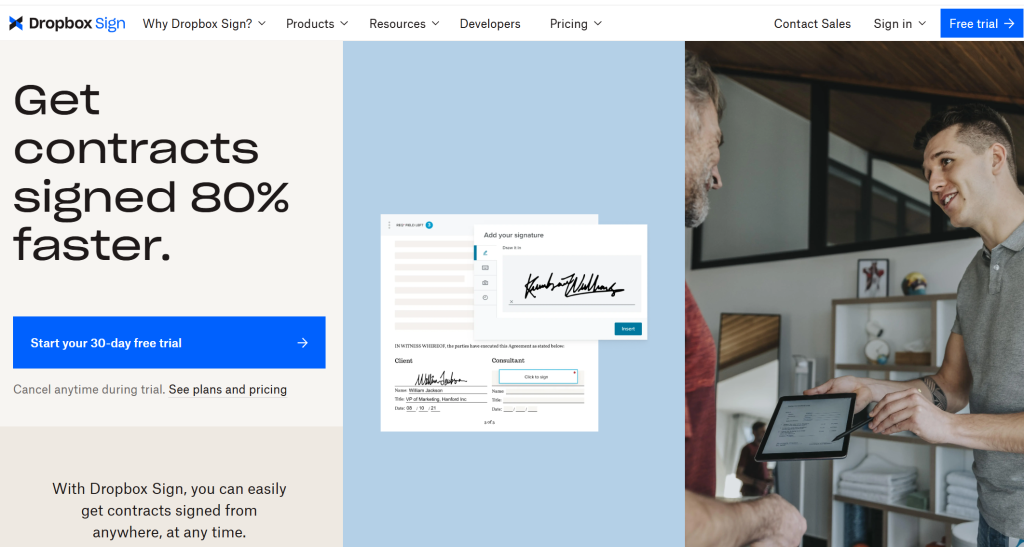
Best for: Teams that want a simple, reliable tool with tight Dropbox integration.
Dropbox Sign (formerly HelloSign) is a focused e signature platform built around cloud storage. It connects to Dropbox and other popular cloud storage services so your files are always at hand. Thirty days, no cap. It doesn’t cover the same document automation depth as PandaDoc, but Dropbox Sign’s status tracking is built in and the signing workflow runs cleanly across desktop and mobile.
- Tight Dropbox integration with automatic file syncing
- Tamper-evident audit trail and signing certificate
- API for embedding signatures into your own product
- Integrations with Salesforce, Gmail, Slack and HubSpot
Limitations:
- No permanent free plan after the trial ends
- Limited for complex multi-step workflows
- Signature-focused; not a document management platform
Pricing: Starts at $15/user/mo. The free trial runs 30 days with no document cap.
6. Zoho Sign
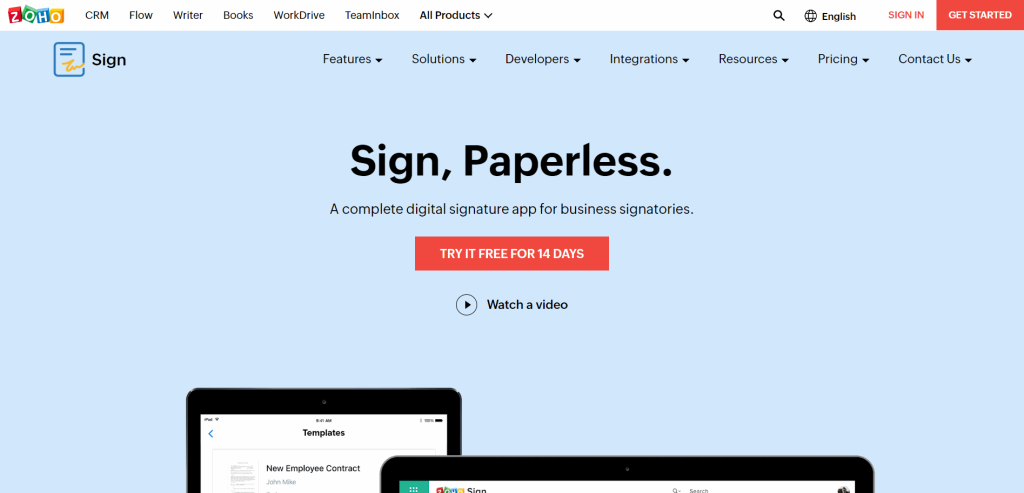
Best for: Businesses already on the Zoho platform needing an affordable e-signature add-on.
For existing Zoho users, the fit is immediate. Cost efficiency is the standout: at $10/mo billed annually, you get blockchain-based timestamping, government ID verification and support for 22 languages. Tight integrations with Zoho CRM, HubSpot and Pipedrive make it a strong add-on across the full suite. SignNow has more integrations overall and supports payment collection. Neither feature’s on the Zoho Sign roadmap.
- Zoho CRM, Books and People integrations; plus HubSpot and Pipedrive
- Blockchain timestamping for document integrity
- Government ID verification and SMS authentication
- Bulk sending and automatic cloud backup
Limitations:
- Narrower integrations outside the Zoho ecosystem
- No payment collection with signatures
- Less enterprise compliance depth than DocuSign or Adobe
Pricing: Paid plans start at $10/mo billed annually. There’s also a limited free plan for testing.
7. Signeasy
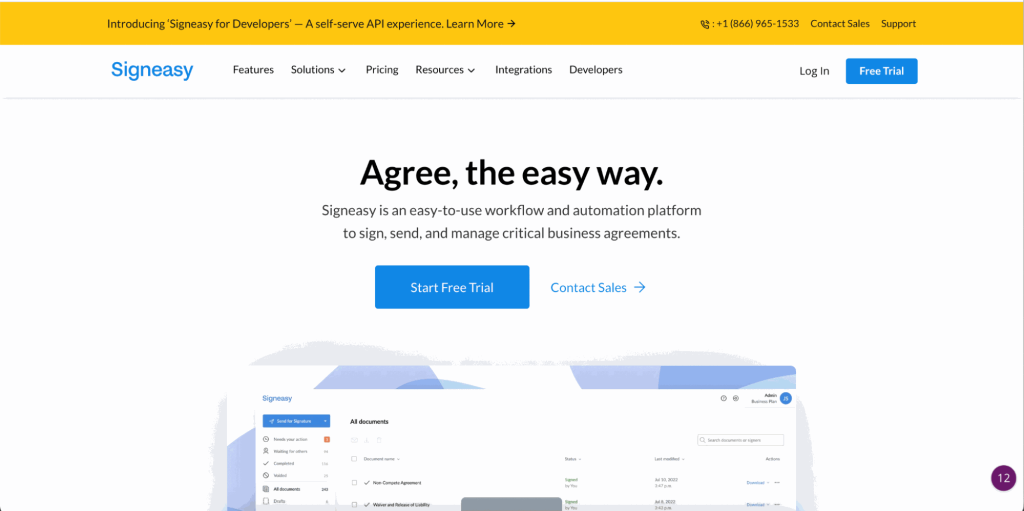
Best for: Fast-growing teams that need mobile-first signing with no learning curve.
Signeasy’s mobile apps are the best in this comparison. Dead simple to use. New users sign their first document without guidance; even people who’ve never used an e-signature tool before pick it up on the first try. It connects to Google Workspace, Salesforce and Microsoft Teams. Paid plans include in-person signing and unlimited templates; that’s $10/user/mo.
- Mobile-first iOS and Android apps with offline signing
- Unlimited templates and reusable document packages
- In-person signing mode
- Integrations with Google Workspace, Salesforce, Outlook and Teams
Limitations:
- Less document automation depth than PandaDoc
- No document merging across multiple files
Pricing: Starts at $10/user/mo. A free trial is available.
8. Xodo Sign
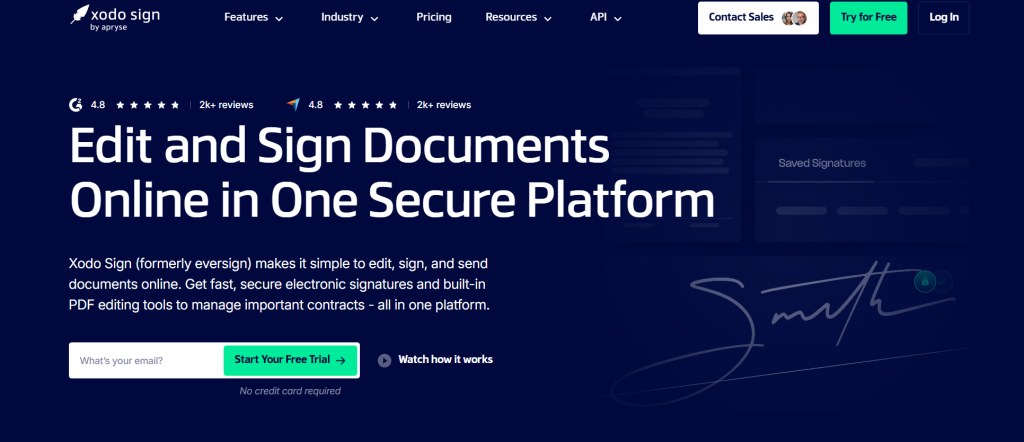
Best for: Teams wanting unlimited e-signatures with a built-in PDF editor at a low entry price.
Xodo Sign combines e-signatures with a drag and drop editor for PDF documents. That removes the need for a separate tool when you’re preparing files before sending. Free plan: up to 3 documents per month. The $16/mo Pro plan adds custom branding, in-person signing and an AI document summarizer. SOC 2 compliance puts it clearly ahead of most low-cost tools on security.
- Drag and drop editor for PDF documents; SOC 2 compliant
- Free plan (3 docs/mo); Basic at $10/mo
- Bulk sending and custom branding (Pro)
- In-person signing and AI document summarizer (Pro)
Limitations:
- Free plan capped at 3 documents per month
- Full feature set requires the $16/mo Pro plan
- Smaller brand presence than DocuSign or Adobe
Pricing: Free plan available. Basic at $10/mo; Pro at $16/mo.
9. DigiSigner
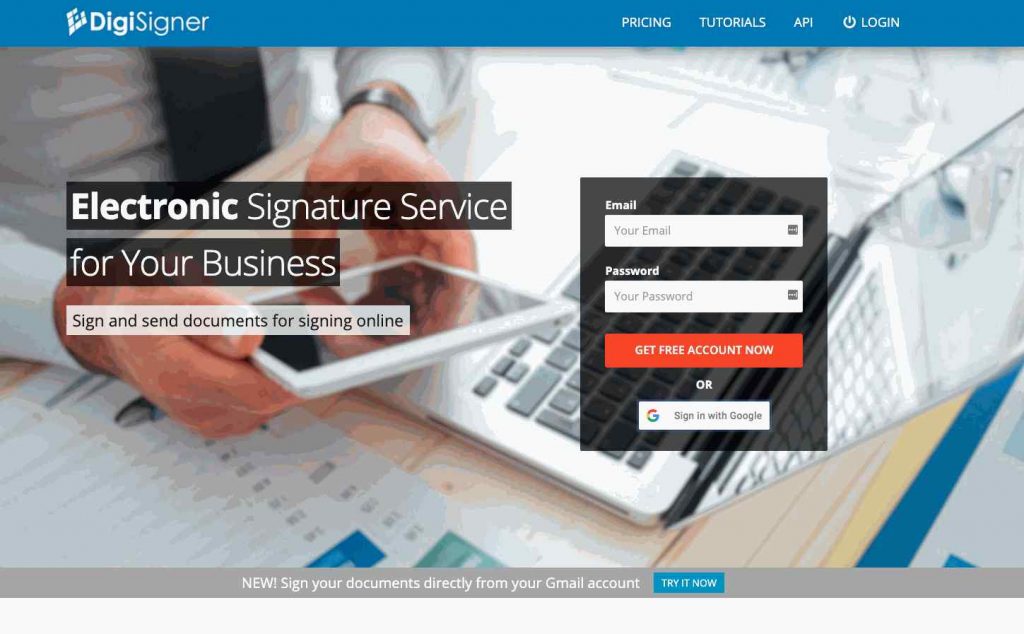
Best for: Small businesses and real estate professionals needing straightforward, no-frills signing.
DigiSigner keeps the document signing process simple. It supports multiple signers, customizable signature fields and camera-based capture. That combination’s well suited to real estate transactions where clients sign legally binding documents from a phone for the first time. SignNow provides more integrations and document merging on mobile; DigiSigner’s the better pick for cost efficiency when you don’t need all that.
- Multiple signature methods including camera capture
- Multiple signers with customizable signing order
- ESIGN, UETA and eIDAS compliant; SSL encryption throughout
- API for custom integrations
Limitations:
- Fewer out-of-the-box integrations; primarily API-based
- No bulk sending on the base plan
- Less suited for teams that need workflow automation
Pricing: Pro plan at $25/mo; Team plan at $75/mo. A free trial is available.
10. SignRequest
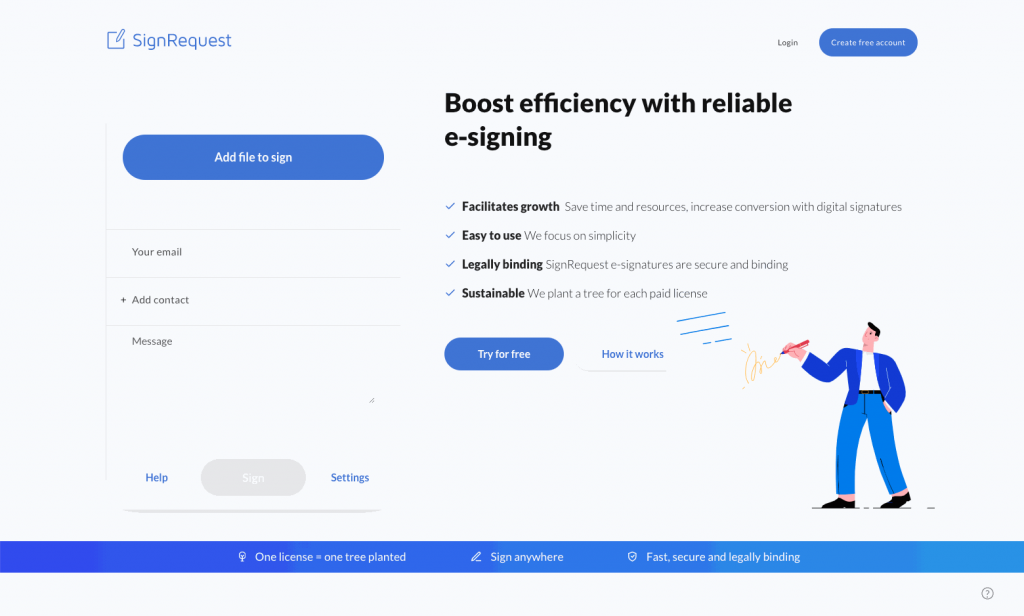
Best for: Small European teams needing a GDPR-compliant tool at the lowest price.
SignRequest’s free plan needs no credit card. Paid plans start at $9/user/mo. It plugs into CRM systems like Salesforce and Zapier, and it’s ISO 27001 certified with support for 17+ languages. That’s a strong combination for lean European teams that need legal compliance without complexity. The feature set’s smaller than DocuSign or PandaDoc, but the unique signing link and basic workflow controls cover most small-team needs.
- Unique signing link for open or bulk sign requests
- Sequential signing and automated status notifications
- Custom branding and 17+ language support; ISO 27001 certified
- Integrations with Slack, Zapier and Salesforce
Limitations:
- No document library or field validation features
- Fewer integrations than SignNow
- Smaller feature set than DocuSign or PandaDoc
Pricing: Free plan available. Professional at $9/user/mo; Business at $15/user/mo. Both include a free trial.
How to Choose the Best SignNow Alternative for Your Business
Pick the wrong e signature solution and you’ll pay to switch later. The right choice comes down to four factors: what you need the document workflow to handle, how many users, whether you’re in a regulated industry and how often your team signs documents away from a desk.
What do you need beyond signatures?
If you’re looking for a straightforward e signature platform for sending and requesting signatures, Signaturely, DigiSigner and SignRequest handle that at a low cost. Need contract management, proposals and document tracking alongside signatures? PandaDoc’s the stronger pick. Most teams don’t need heavy automation to start. Try a simpler tool first.
What’s your team size and budget?
Solo users and small teams get the most value from Signaturely Personal, DigiSigner or SignRequest’s free or low-cost plans. Mid-sized teams sending frequent documents benefit from PandaDoc, Zoho Sign or Signeasy. Enterprise clients with large user counts should evaluate DocuSign and Adobe Acrobat Sign; the per-user cost is higher, but nothing else comes close on compliance depth.
Do you need compliance or identity verification?
Regulated industries don’t just need legally binding esignatures. They need enterprise grade compliance that holds up to audits. DocuSign holds HIPAA and FedRAMP certifications; Zoho Sign adds government ID verification and blockchain timestamping on top of that. Adobe covers enterprise security at scale, and Xodo Sign’s SOC 2 compliant. Match the tool to your certification requirements before signing up.
Do you need mobile signing?
Signeasy’s mobile apps are the most polished in this comparison. They support offline signing on iOS and Android and handle small screens without the layout issues you’ll find in desktop-first tools. DocuSign and Dropbox Sign also have solid mobile apps. If your customers or field staff sign from a phone, put mobile UX first during your trial period.
SignNow Alternative FAQs
These questions come up most when teams compare SignNow to other options.
Both are solid e signature software options, but DocuSign leads on enterprise compliance and integrations for regulated industries. SignNow’s cheaper and faster for small teams that only need basic signing. Neither is universally better; it’s down to your compliance requirements.
All paid plans come with a free trial, but there’s no permanent free tier. The trial gives you enough time to test the core features before committing to a plan.
SignNow meets the requirements of the ESIGN Act and eIDAS. All documents signed through the platform are legally binding in the US and EU. Our guide to the ESIGN Act covers what qualifies an e-signature as enforceable.
Signaturely, Xodo Sign and SignRequest all offer permanent free plans. Signaturely covers 1 document per month, Xodo Sign allows 3 documents per month and SignRequest’s free tier has no monthly subscription fee.