
Commission Agreement Template
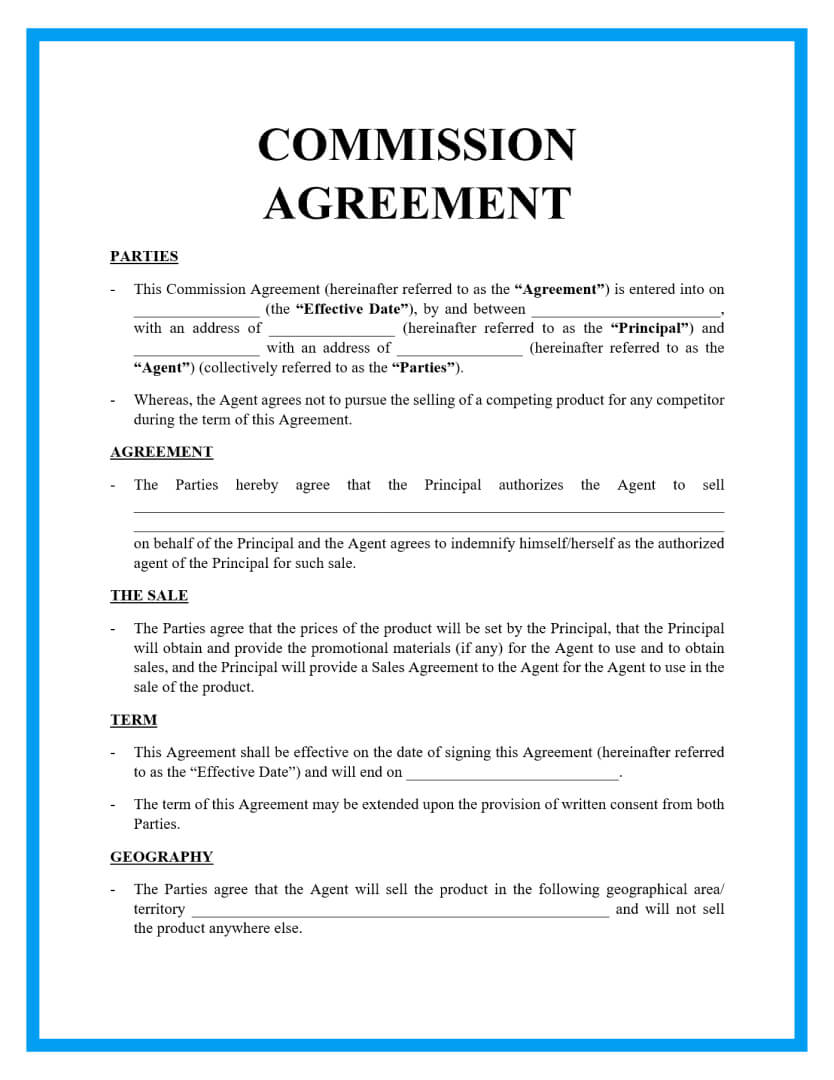


Free Downloadable Commission Agreement Template
- • Geography/non-compete terms
- • Commission earnings and structures
- • Termination clauses
What is a commission agreement?
A commission agreement is a written contract in which a principal (the company) agrees to pay an agent (the salesperson) a commission, usually a share of the revenue or profit from the sales the agent makes. Commission is variable pay: the more the agent sells, the more the agent earns.
A commission agreement is a formal contract between an agent and a principal that captures the terms of the revenue share for both sides.
In short: a commission agreement states what the agent sells, where, at what commission rate and base, when the commission is paid, what happens on refunds and how either side ends the deal. Both sides sign it before the first sale.
DISCLAIMER: We are not lawyers or a law firm and we do not provide legal, business or tax advice. We recommend you consult a lawyer or other appropriate professional before using any templates or agreements from this website.
Download our free Commission Agreement Templates
Your commission contract is also a powerful business document that challenges you to get clear on the most beneficial commission structure for agents and your company.
Why is a commission agreement important?
When should you use a sales commission contract?
Download our free Commission Agreement Template
Best practices when using a commission sales agreement
1. Get face to face with new agents
2. Be specific in your commission structure
3. Be transparent
What to Include in a Commission Agreement
A commission agreement should name the parties, the products and the territory, the commission rate and what it is based on, when a commission is earned and paid, how refunds and chargebacks are handled and how either side can end the agreement. The template covers parties, product, term, territory and termination. The checklist below adds the commission clauses that most templates leave to you.
Parties, products and territory
Name the principal and the agent with their addresses, describe the products or services the agent may sell and name the territory. The template has a blank for each in the Parties, Agreement and Geography sections. Say whether the agreement is exclusive. The Relationship Of The Parties section of this template makes it non-exclusive and treats both sides as independent contractors, so change that line if you want an exclusive agent.
Commission rate and base
State the rate and the base it applies to, because 10 percent of revenue and 10 percent of profit pay very different amounts. Say whether the base is gross revenue, net revenue or profit, whether returns and discounts reduce it and whether the rate steps up in tiers. The Commission Earnings section has a single blank for how the agent is paid, so write the rate, the base and the payment date there or attach a commission schedule.
When commissions are earned and paid
Define the moment a commission is earned: when the contract is signed, when the invoice is issued or when the customer has paid. Then set the payment date, for example the 15th of the month after the sale. Without a trigger and a date, the agent and the principal can each read the same sale differently.
Refunds, chargebacks and clawbacks
A clawback lets the principal recover a commission that was already paid when the customer later returns the product, requests a refund or does not pay. Say which events trigger it, how long after the sale it can apply and whether the principal deducts it from the next payout. The template has no clawback clause, so add one if refunds are possible in your business.
Termination and tail commissions
The Termination section lets either side end the agreement on written notice of a number of days you enter, or immediately on a breach. Add what happens to deals the agent started before the end date. A tail commission pays the agent a commission on sales that close after termination, usually for a set period. Decide whether you offer one and write the period down.
Independent Contractor or Employee: What the Law Requires in Writing
Whether an agent is an independent contractor or an employee depends on how much control the principal has, not on the label in the agreement. The IRS sorts the evidence into three categories: behavioral control (does the company control what the worker does and how), financial control (how the worker is paid, whether expenses are reimbursed and who provides tools and supplies) and the type of relationship (such as written contracts and employee type benefits). It says all evidence of control and independence has to be considered. Read the IRS guidance on independent contractors and employees before you decide.
Contractor or employee
This template treats both parties as independent contractors in the Relationship Of The Parties section. If your agent works under your direction on your schedule, the IRS common law rules may point to an employee. In that case the agreement belongs next to an employment contract, and your state may set extra rules for commission pay. Our independent contractor agreement template covers the contractor side in detail.
Written agreement rules in California and New York
Some states require a written commission agreement for employees. In California, when an employer pays an employee through commissions, the contract must be in writing and set out how the commissions are computed and paid, the employer must give the employee a signed copy and the employer must obtain a signed receipt (California Labor Code 2751). In New York, the agreed terms with a commission salesperson must be in writing and signed by both the employer and the salesperson, and the employer must keep them on file for at least three years. The writing has to describe how commissions are calculated, how a recoverable draw is reconciled and how payment works on termination. Commissions are due at least once a month and no later than the last day of the month after they are earned (New York Labor Law 191). If the employer cannot produce the writing, the salesperson’s version of the terms is presumed to be the agreed terms. Other states have their own rules, so check yours.
Commission Agreement Example: How a Commission Is Calculated
A commission equals the commission rate times the sales base. These numbers are an illustration, not a benchmark.
- Flat rate above a threshold: an agent sells $8,000 in a month and earns 10 percent of the revenue above the first $1,000. The base is $8,000 minus $1,000, which is $7,000, and 10 percent of $7,000 is $700.
- Tiered rate: the agent earns 5 percent on the first $5,000 and 8 percent on the rest. On $8,000 the first tier pays $250 and the remaining $3,000 pays $240, so the commission is $490.
- Clawback: the customer refunds a $2,000 order that paid a 10 percent commission of $200, and the principal deducts $200 from the next payout.
Write the rate, the base, the threshold or tiers and the payment date into the Commission Earnings section so the agent can recompute every payout.
Common Mistakes in Commission Agreements
Most commission disputes start with a vague base, a missing payment date, silence on refunds or termination, or an agreement that nobody signed. Each mistake below has a clause that prevents it:
- Vague sales base: say whether the rate applies to gross revenue, net revenue or profit.
- No payment timing: set the trigger that earns the commission and the date it is paid.
- No clawback rule: state what happens to a paid commission when a customer returns the product or does not pay.
- No termination terms: set the notice period and say what happens to open deals and tail commissions.
- Contractor terms with employee control: if you set the agent’s hours and methods, the contractor label may not hold.
- No signature: an unsigned agreement is hard to enforce, so have both parties sign.
How to Fill Out, Edit and Sign the Commission Agreement Template
Download the template as a Word file to edit on screen or as a PDF to print and complete by hand, fill in every blank, set the commission terms and have both parties sign. Follow these steps to complete it.
- Download the free commission agreement template as a Word file or a printable PDF.
- Enter the Effective Date and the names and addresses of the principal and the agent in the Parties section.
- Describe the product in the Agreement section and name the territory in the Geography section.
- Write the commission rate, the base and the payment date in the Commission Earnings section.
- Set the end date in the Term section and the notice period in the Termination section.
- Add the clauses your deal needs, such as a clawback rule and a tail commission, and delete any you do not need.
- Fill in the governing law, then send the agreement for signature.
You can collect the signatures on paper or electronically. Under 15 U.S.C. 7001, a signature or contract may not be denied legal effect, validity or enforceability solely because it is in electronic form. An e-signature tool like Signaturely lets the agent sign from any device while you track the request. Our guide to the ESIGN Act explains the rule in more detail.
Check before you send the agreement: the names and addresses, the product and the territory, the commission rate and base, the payment date, the notice period, the governing law, any clauses you added and the signature lines for both parties.
If your agent only refers customers and does not sell, our referral agreement template may fit better. For a one-time sale of goods, see the sales contract template.
Commission Agreement Questions
What should be in a commission agreement?
A commission agreement should state the parties, the products and the territory, the commission rate and base, when commissions are earned and paid, how refunds and clawbacks work, the term and how either side can terminate. The sections above explain each part.
Is a commission agreement legally binding?
A commission agreement is legally binding once both parties sign it and each side gives something of value, such as sales effort in return for a commission. Rules for commissioned employees differ by state, so have a lawyer check larger changes to the template.
Can an independent contractor have a commission agreement?
An independent contractor can work under a commission agreement, and this template treats the agent as one. The classification still depends on how much control the principal has over the work, so review the IRS common law factors before you rely on the label.
Can a commission agreement be signed electronically?
A commission agreement can be signed electronically. Under 15 U.S.C. 7001, a contract may not be denied legal effect, validity or enforceability solely because an electronic signature was used in its formation.
FAQ about our Commission Agreement Template
While not necessary, It’s considered best practice to send a commission letter with your commission agreement for agents to review and sign.
- Any party breaches the conditions of the agreement
- Any party gives written notice to another party based on the agreed notice period
Just keep in mind that if you make any drastic changes, it might be worth getting a lawyer to review it.