



A notary public is an official commissioned by a state to witness signatures, identify signers and administer oaths. When a notary completes a notarization, they record it in a signature block on the document, also called the notarial certificate. This block is what turns a signed paper into a notarized one.
In this guide we explain what a notary signature block is, what it must contain, how seal rules differ by state, what sample acknowledgment and jurat wording looks like and how electronic and international notarizations change the block.
What Is a Notary’s Signature Block?
A notary’s signature block is the notarial certificate section of a document where the notary states what they did and signs it. It usually holds the venue (state and county), the certificate wording for the notarial act, the date, the name of the signer, the notary’s signature, the notary’s printed name and title, the commission number, the commission expiration date and the notary seal or stamp.
The Revised Uniform Law on Notarial Acts (RULONA), which many states have adopted in some form, requires the certificate to be completed at the time of the notarial act, signed and dated by the notary, and to show the jurisdiction, the notary’s title and the commission expiration date. (Source: RULONA 2018, Section 15)
Why Is a Notary’s Signature Block Important?
A notary’s signature block is important because it is the written proof that a commissioned official identified the signer and performed a specific notarial act. Without it, a document that needs notarization is not notarized, even if a notary was in the room.
The block sits at the end of a legal document, usually near the signatures, or on a loose certificate attached to it. It tells a court, county recorder or bank who notarized the document, where they were authorized and when they acted. That is why a recorder or court can reject a document whose certificate is missing information.
This helps prevent fraud. A notarized purchase agreement between two private parties gives both sides a record that each signer was identified and signed in front of the notary, which makes later disputes about who signed much harder to raise.
What Should Be Included in a Notary Public Signature Block?
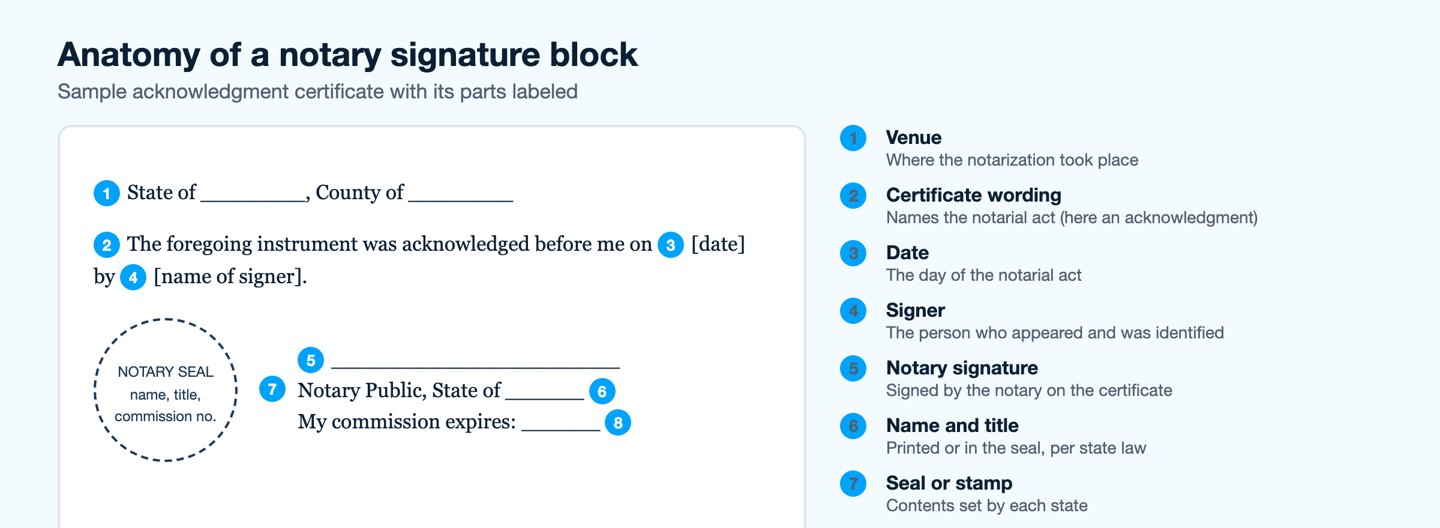
A notary public signature block should include the venue, the certificate wording, the date, the signer’s name, the notary’s signature, the notary’s printed name and title, the commission number, the commission expiration date and the seal or stamp information required by the state. Missing pieces can lead a recorder or court to reject the document. Here is what each element does.
The Venue
The venue line (“State of ____, County of ____”) records where the notarization took place. It shows that the notary acted inside the area where they are commissioned.
The Certificate Wording
The certificate wording states which notarial act was performed, for example an acknowledgment or a jurat. Each act has its own wording, so a notary needs the right certificate for the act the document calls for.
The Notary’s Name and Title
The name of the notary must be legible so anyone reading the document can identify who notarized it. Most states also require the title “Notary Public” with the state name, either in the seal or printed below the signature.
The Notary’s Signature
The notary’s signature confirms that the notary identified the signer and completed the act. The other details are often on a rubber stamp, but the notary signs the block by hand on paper documents. Learn more about wet signatures and when they are still used.
The Notary’s Seal or Stamp
The seal or stamp identifies the notary’s commission. Its contents are set by state law, and notaries usually buy it from a stamp vendor once their commission is issued. In California the seal must even carry the manufacturer or vendor ID number. (Source: Cal. Gov. Code § 8207 (CA Notary Handbook)) New York is an exception: it requires the notary’s details in black ink below the signature but does not mention a seal. (Source: N.Y. Executive Law § 137)
The Commission Number
The commission number (called an identifying number in some states) is assigned by the state and ties the notary to their commission record. Several states require it in the seal.
The Commission Expiration Date
The commission expiration date shows that the notary’s commission was active on the date of the notarization. A notary whose commission has expired may not perform notarial acts, so always check this date.
How Do Notary Seal Rules Differ by State?
Notary seal rules differ by state because each state sets the required contents of the seal in its own statute. The table below compares four large states.
| State | Seal required? | What the seal or block must show | Source |
|---|---|---|---|
| California | Yes | Notary’s name, State Seal, the words “Notary Public”, county where the bond and oath are filed, commission expiration date, plus commission number and manufacturer or vendor ID for commissions since 1992 | Cal. Gov. Code § 8207 (CA Notary Handbook) |
| Florida | Yes, rubber stamp on paper documents | Notary’s name, “Notary Public-State of Florida”, commission expiration date, commission number, in black ink; an embosser may be added but cannot replace the stamp | Fla. Stat. § 117.05(3)(a) |
| Texas | Yes | “Notary Public, State of Texas” around a five-pointed star, notary’s name, identifying number, commission expiration date | Tex. Gov. Code § 406.013 |
| New York | No seal mentioned | Below the signature in black ink: name, “Notary Public State of New York”, county where originally qualified, commission expiration date | N.Y. Exec. Law § 137 |
California and Texas also require the seal to reproduce legibly when the document is photocopied or scanned, which is why notaries should not stamp over text or signatures.
How Do I Create a Notarized Signature Block?
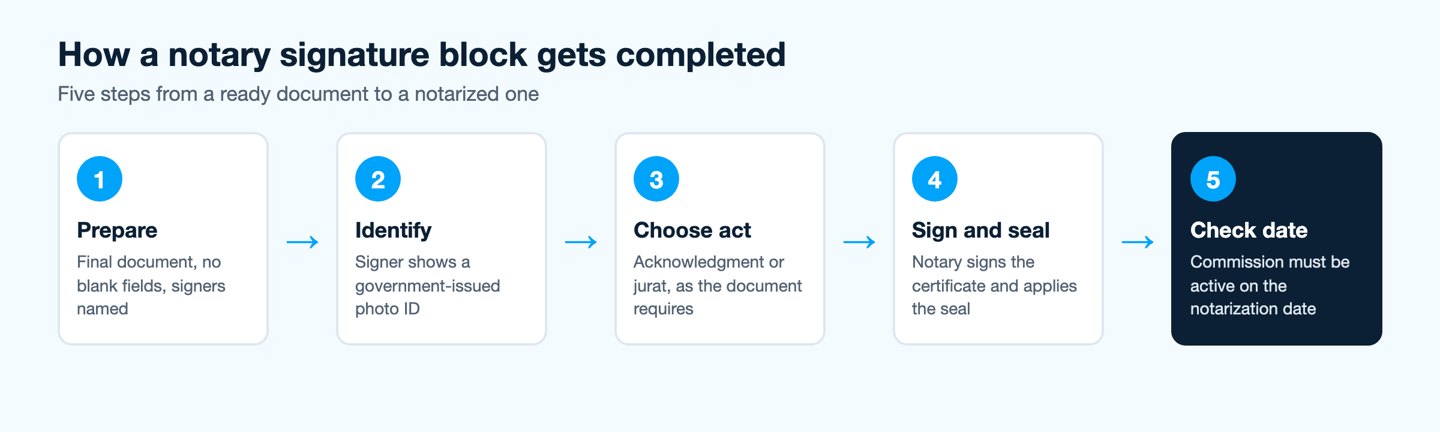
To create a notarized signature block, prepare the document, identify the signer, choose the certificate for the notarial act the document requires and then complete it with the notary’s signature, seal and commission details. Here is a step-by-step guide:
Prepare the Document
Before a notary can notarize your document, it needs to be complete and ready to sign. Do a final review to make sure the terms are correct, there are no blank fields and the correct signers are named.
Verify the Signer’s Identity
The notary must identify every signer, usually by reviewing a government-issued photo ID. Some states also allow personal knowledge or a credible witness. The notary does not check whether the document’s contents are true; they confirm who is signing.
Choose the Right Certificate
The document, the person who drafted it or the receiving agency decides which notarial act is needed. The notary completes the matching certificate (acknowledgment or jurat, for example) but should not choose the act for the signer.
Include the Notary’s Signature
Just as important as the parties’ signatures is the notary’s own signature on the certificate. Without it, the notarization is incomplete.
Apply the Notary’s Seal
Where state law requires a seal, the notary applies it next to their signature. It must be clear and must not cover any text or signatures.
Note the Commission Expiration Date
Notary commissions run for a fixed term. The expiration date appears in the seal or below the signature, depending on the state.
For a ready-made layout, see Signaturely’s notary signature template.
Notary Signature Block Examples
Notary signature block examples fall into two main types: the acknowledgment and the jurat (also called a verification on oath or affirmation). The exact wording is set by state law, so always use the form your state requires.
An acknowledgment confirms that the signer appeared before the notary, was identified and declared that they signed the document for the purpose stated in it. RULONA defines it as a declaration that the individual signed the record for the stated purpose. (Source: RULONA 2018, Section 2(1)) A typical acknowledgment block reads:
Sample acknowledgment wording: State of ____, County of ____. The foregoing instrument was acknowledged before me on [date] by [name of signer]. [Notary signature], Notary Public, State of ____. My commission expires: ____. [Seal]

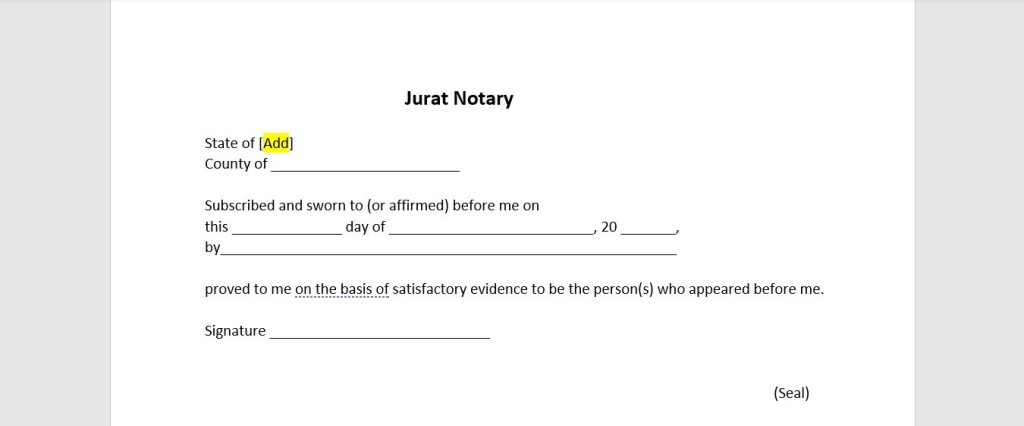
A jurat confirms that the signer swore or affirmed, in front of the notary, that the statements in the document are true. The notary still has to identify the signer. RULONA calls this a verification on oath or affirmation. (Source: RULONA 2018, Section 2(15)) A typical jurat block reads:
Sample jurat wording: State of ____, County of ____. Subscribed and sworn to (or affirmed) before me on [date] by [name of signer]. [Notary signature], Notary Public. My commission expires: ____. [Seal]
When someone signs on behalf of a company or another person, the acknowledgment names that capacity, for example “as president of ABC Corp.” or “as attorney-in-fact for [name]”. Many states publish separate acknowledgment forms for corporations, LLCs and attorneys-in-fact.
How Can I Ensure My Signature Block for Notary Is Legally Compliant?
To make sure your notary block is legally compliant, use the certificate wording your state requires, confirm that the commission is active and place the seal and signature correctly on the document. Here are the key points:
Check Legal Requirements
Notary laws differ from state to state and country to country. Seal contents, certificate wording and identification rules all vary, as the state table above shows.
Verify Commission Validity
Check the commission expiration date, whether you are having a document notarized or you are the notary. A notarization by a notary whose commission has expired can be rejected, and the notary can face penalties under state law.
Place the Seal Correctly
The seal or stamp belongs on the certificate, next to the notary’s signature. Placing it on another page or over text can cause the recorder or receiving agency to reject the document.
Include All Necessary Details
Include every element listed above: venue, certificate wording, date, signer name, notary signature, name and title, commission number and expiration date. For guidance on creating legally sound documents, check out Signaturely’s contract templates.
What Are Common Mistakes to Avoid in Notary Signature Blocks?
Common mistakes in notary signature blocks include missing information, incorrect dates, illegible writing and improper seal placement. Whether you need a notary or you are the notary, check for these before the signer leaves.
Missing Key Information
A missing element can get a notarized document rejected by a recorder or receiving agency. Make sure the venue, name, signature, seal and commission details are all present before you finish.
Incorrect Dates
The date in the certificate must be the date of the notarial act. A wrong date can create legal problems if the document is ever disputed.
Illegible Writing
If the notary completes parts of the block by hand, the writing must be easy to read. This matters most for the notary’s name, the commission number and the expiration date.
Improper Seal Placement
Place the seal near the notary’s signature on the certificate and keep it clear of text and signatures so it reproduces in copies and scans.
Wrong Certificate Type
Using an acknowledgment where the document requires a jurat, or the reverse, means the wrong act was performed. Match the certificate to the act the document calls for.
Electronic Notary Signature Blocks: What You Need to Know
An electronic notary signature block is valid under federal law when the notary’s electronic signature and all other information required by state law are attached to or logically associated with the record. (Source: 15 U.S.C. § 7001(g)) The federal rule does not require an image of a stamp or seal, but state law can still require the seal information as part of the “other information”.
More business is done online, so electronic and remote online notarization (RON) has spread quickly. Virginia was the first state to authorize remote electronic notarization, in 2011, and the National Association of Secretaries of State lists 47 states plus Washington, D.C. with a law that allows remote electronic notarization. (Source: NASS) A remote notarization must be performed by a commissioned notary on a platform approved under the state’s notary law, usually with audio-video identity checks.
The components of an electronic block match the paper version: venue, certificate wording, date, signer name, the notary’s electronic signature, name and title, commission number and expiration date. Signaturely handles the electronic signing itself, in line with the ESIGN Act and UETA, but it does not perform notarizations.
How to Correct Errors in a Notary Signature Block?
To correct an error in a completed notary signature block, the safest course is to notarize the signature again with a new certificate rather than alter the old one. The California Secretary of State’s Notary Public Handbook says no law allows a completed notarial act to be corrected, and that the notary should perform a new notarization with all the usual requirements, a new certificate dated with the new date and a new journal entry. (Source: California Notary Public Handbook 2025, p. 19) Virginia’s notary handbook also recommends a new notarization as best practice.
Practice in other states varies, so a notary who spots a mistake should check their state’s handbook before making any change. Signers who receive a document with a defective certificate should ask the notary, or another notary, to notarize the signature again rather than edit the block themselves.
What Are International Considerations for Notary Signature Blocks?
A notarized document for use in another country usually needs an apostille or a legalization on top of the notary signature block. Under the Hague Apostille Convention, notarial acts count as public documents, and between member countries a single apostille from the competent authority where the document was issued replaces the longer legalization chain. (Source: Hague Apostille Convention, Articles 1 to 3)
For a document notarized in a U.S. state, the apostille comes from that state’s competent authority, which is generally the Secretary of State’s office. Documents issued by federal agencies go to the U.S. Department of State instead. (Source: HCCH, United States competent authorities) Countries that are not party to the convention usually require legalization through their embassy or consulate, so check the receiving country’s rules before you send the document.
FAQ
Yes, a statement can vary from state to state, so it’s important to familiarize yourself with local requirements.
There is no single national format, but many states prescribe the certificate wording in their notary law, so use your state’s statutory form for the act being performed.
No – a ‘notarized’ document without a notarial certificate and the notary’s signature isn’t actually notarized. If the law requires notarization for that document, it may not be accepted or recorded without it.
An acknowledgment block confirms the signer was identified and declared they signed willingly, while the jurat block confirms the signer swore or affirmed that the document’s contents are true.
Only if the law or the receiving party requires notarization. In that case the notary’s electronic signature and the required notary information must be attached to or logically associated with the record under 15 U.S.C. 7001(g).