
Agency Agreement Template
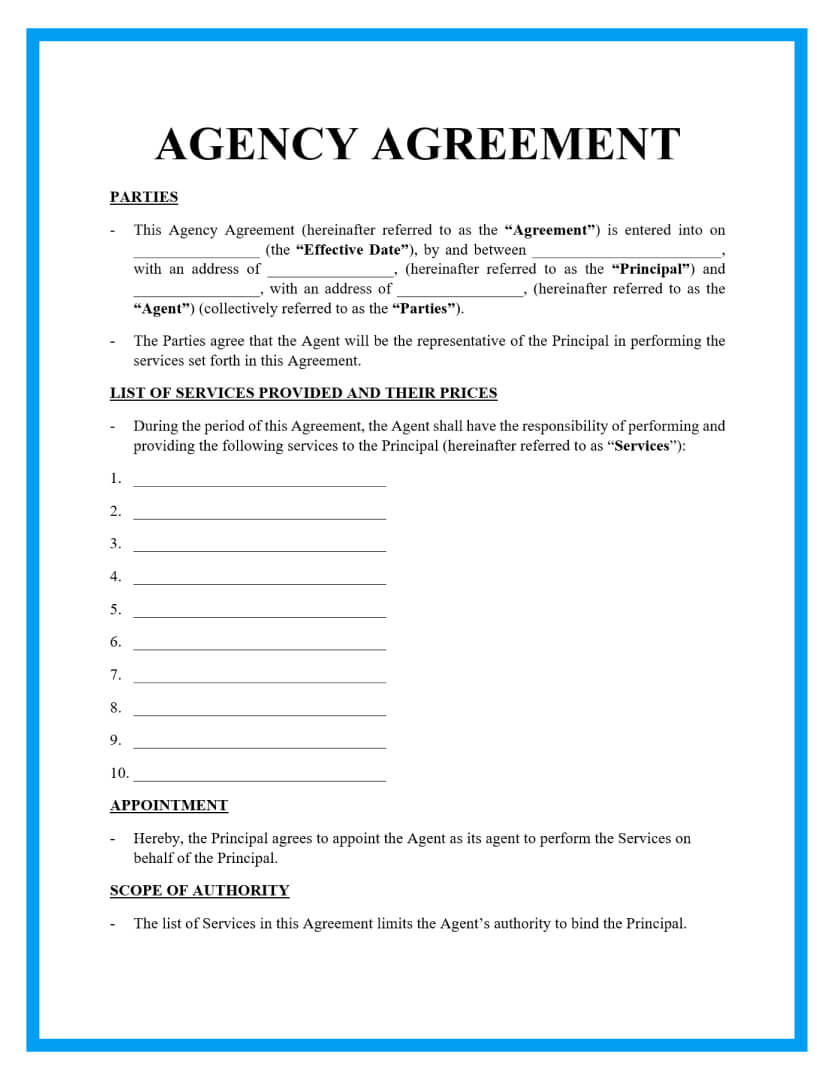


Free Agency Agreement Template for Download
- • List of services provided
- • Scope of authority
- • Compensation terms
What is the purpose of an agency agreement?
- • An athlete hires a sports agent to manage all of their contracts and marketing opportunities.
- • A retired couple hires a real estate agent to sell their family home.
- • An eCommerce brand hires a marketing agency to advertise on their behalf.
An agency agreement, also called an agency contract, is a legally binding written contract in which a principal authorizes an agent to act on their behalf, and it sets out the services, the agent’s authority, the pay, the term and the confidentiality terms.
DISCLAIMER: We are not lawyers or a law firm and we do not provide legal, business or tax advice. We recommend you consult a lawyer or other appropriate professional before using any templates or agreements from this website.
Download our free agency
contract forms
Agency law can get intricate, so we built a simple, customizable template you can use in all of your agency dealings. Edit the Word file or print the PDF as a blank copy.
Why is the contract of agency important?
Elements of an agency agreement
1. Services
2. Compensation
3. Confidentiality
4. Termination
5. Signatures
An agency contract needs consent from both the principal and the agent. Signatures show that each side has read and accepted the terms of the agreement.
What does our agency agreement template cover?
Our agency agreement template covers 20 short sections, from the parties and the list of services to the signatures, and each section has blank lines you complete before signing. The sections fall into six groups.
- Parties and appointment: the effective date, the names and addresses of the principal and the agent, and the principal’s appointment of the agent to perform the listed services.
- Services and scope of authority: up to ten numbered service lines. The agent can bind the principal only for those services.
- Term and compensation: the agreement starts on signing and ends on the date you enter, with no automatic renewal. The agent gets paid by invoicing the principal in the way you describe.
- Relationship, confidentiality and intellectual property: the agreement is non-exclusive and the agent isn’t an employee. Confidential information stays private after the agreement ends, and each side keeps the intellectual property it provides.
- Termination: either side can end the agreement immediately after a breach or at any time by written notice with the number of days you enter, and each side has termination rights if the other becomes insolvent. The agent returns the principal’s products and content within the number of days you set.
- Risk and general terms: representations and warranties, limitation of liability, indemnity, severability, governing law, amendments in writing, assignment, the entire agreement and dispute resolution by arbitration, mediation or negotiation.
The template has no territory clause and no exclusivity option. Write the territory into the service lines, for example “Sales of the product line in Texas,” and use the Compensation section for commission and expenses. Have a lawyer review the limitation of liability and indemnity sections before you rely on them, because the right terms depend on your state and your deal.
What are exclusive and non-exclusive agency agreements?
An exclusive agency agreement gives one agent the right to represent the principal for a defined job or market, and a non-exclusive agreement lets the principal appoint other agents for the same work. Some documents call the exclusive version a sole agency, and people use the two terms loosely, so spell out in writing whether the principal can still sell directly and whether the agent then earns a commission.
Our template is non-exclusive, and the Relationship of the Parties section says so in one sentence. If you need an exclusive arrangement, change that sentence in the Word file, add the territory and commission rules you agreed and have a lawyer check the result.
How is an agency agreement different from an independent contractor agreement?
An agency agreement lets the agent act for the principal and create obligations with third parties, while an independent contractor or service agreement covers work the contractor does for a client without that authority. The agent’s authority to act in the principal’s name is the main difference.
Our template limits that authority to the listed services and states that the parties aren’t employer and employee. The label alone doesn’t settle the legal status, though. The IRS looks at behavioral control, financial control and the type of relationship, and a written contract is one of the facts it weighs (IRS guidance on independent contractors and employees). If the work doesn’t involve acting for you, our independent contractor agreement template or service agreement template fits better.
How do you pay an agent: commission, flat fee or retainer?
You can pay an agent a commission, a flat fee, an hourly rate or a monthly retainer, and the Compensation section of the template has a blank line where you write the method. Pick the model that matches how the agent earns the money, then put the amount and the payment dates in writing.
- Commission: a percentage of the revenue the agent brings in, which suits sales agents. Say which sales count and when the agent earns the commission.
- Flat fee: one price for a defined project, such as an introduction to a distributor.
- Hourly rate: the agent invoices the hours worked, which suits work that changes from month to month.
- Retainer: a set monthly amount for a defined list of ongoing services.
Add who pays expenses such as travel to the same line, because the template doesn’t cover them anywhere else. If your agent works as an independent contractor, you generally report payments of $2,000 or more in a year on Form 1099-NEC, according to the IRS instructions for Forms 1099-MISC and 1099-NEC for tax years after 2025. Our commission agreement template goes deeper on commission structures.
How do you fill out and sign an agency agreement?
To fill out the agency agreement template, download the Word or PDF file, complete the blank lines and review the terms with the other party before anyone signs. Use the Word file to type your details, or print the PDF as a blank copy and write them in by hand.
- Enter the effective date and the names and addresses of the principal and the agent.
- List the services on the numbered lines, with the territory or deliverables where they matter.
- Enter the end date of the term. The template doesn’t renew itself, so a longer relationship needs a new agreement or a signed amendment.
- Describe in the Compensation section how the agent invoices you, with rates, percentages and payment dates.
- Set the notice period for termination and the number of days the agent has to return your products and content.
- Enter the governing law and circle arbitration, mediation or negotiation.
- Go through the finished agreement together, then both sign and date it.
Signing comes last, and both parties should sign before the agent starts work. You can sign on paper or electronically. Under the federal ESIGN Act, a signature or contract relating to a transaction in or affecting interstate or foreign commerce can’t be denied legal effect, validity or enforceability solely because it’s in electronic form (15 U.S.C. 7001). Our guide to electronic signature legality explains where that rule applies, and you can upload the finished agreement to Signaturely to send it for signature. Keep a signed copy for each party.
Download our agency contract
template (Word and PDF)
FAQ about our Agency Agreement Template
The length of your agency agreement comes down to the nature and industry of the agency. It’s always a good idea to define a relatively short term for your first contract to give parties an idea of what it’s like to work together. From there, you can extend your agency period with subsequent agreements.
- A principal or agent breaches the conditions of the agreement.
- Any party gives written notice to another party based on the agreed notice period.
- An agent or principal becomes bankrupt or insolvent as a result of the work related to the contract.
- A principal has exclusivity to an agent’s services, meaning that the agent can not perform similar work with another principal.
- An agent has exclusive obligations to a principal—meaning that the principal cannot engage with other agents to carry out similar work.
If you do make significant amendments to your contract, it might be worth consulting a lawyer to review it for compliance.
Agency Agreement
Agency Agreement
Parties
List Of Services Provided And Their Prices
- ___________________________
- ___________________________
- ___________________________
- ___________________________
- ___________________________
- ___________________________
- ___________________________
- ___________________________
- ___________________________
- ___________________________
Appointment
Scope Of Authority
Term
Compensation
Relationship Of The Parties
Confidentiality
Intellectual Property
Termination
- Immediately, in the event that one of the Parties breaches this Agreement.
- At any given time by providing written notice to the other party ______________ days prior to terminating the Agreement.
- By the Principal in the event of the Agent’s breach of this Agreement and/or due to insolvency, bankruptcy and/or liquidation.
- By the Agent in the event of the Principal’s breach of this Agreement and/or due to insolvency, bankruptcy and/or liquidation.