
Free Car Lease Agreement to Use for Your Business
A car lease agreement is a written contract that lets one party use another party’s vehicle for a fixed term in exchange for payments. This page gives you a free car lease agreement template to download, plus a plain-language guide to each clause and the federal rules that apply to consumer leases.
The template is a short lease-only form for two parties, and as written it limits use of the vehicle to personal purposes. If you’re leasing a car to or from a business, change the vehicle usage clause before you sign.


What is a Car Lease Agreement?
A car lease agreement is a legal contract between a lessor, the party that owns the vehicle (often a dealership, a leasing company or a private owner), and a lessee, the party that uses it for an agreed term. The lessee pays for that use but doesn’t become the owner, unless the agreement includes a purchase option and the lessee exercises it.
The agreement records the lease term, the payments, who insures and maintains the car, the mileage allowance, the fees and the buyout price, if there is one. A lease to an individual for personal use that runs longer than four months is a consumer lease under federal rules (12 CFR 1013.2), which adds disclosure requirements covered further down this page.
How Is a Car Lease Different From a Rental or a Loan?
A lease gives long-term use of a car without ownership, a rental covers days or weeks, but a loan ends with the buyer owning the car. The practical line between a lease and a rental is time: a rental runs for days or weeks, while a lease usually runs for a year or more and the lessee uses the car as their own.
- Lease: runs for months to years, the lessor keeps title and the lessee returns the car at the end or buys it if the agreement allows.
- Rental: runs for days or weeks, with a deposit and a damage policy.
- Loan: the buyer owns the car, and each payment builds equity.
- Lease-to-own: payments run over time and the lessee has the option, or sometimes the obligation, to buy the car at the end, often at the residual value.
Why You Need a Vehicle Leasing Agreement
A written lease protects both sides because it fixes the costs, limits and exit terms before anything goes wrong. For the lessor, it sets mileage limits, maintenance duties and a standard for wear, which protects the vehicle’s value. For the lessee, it states the cost, who pays for what and what happens on early termination or a purchase at the end.
Without a written agreement, a dispute comes down to one person’s memory against another’s. A signed document gives a court or an insurer something concrete to read if a claim or a disagreement comes up.
DISCLAIMER: We are not lawyers or a law firm and we do not provide legal, business or tax advice. We recommend you consult a lawyer or other appropriate professional before using any templates or agreements from this website.
What to Include in a Car Lease Agreement
A complete car lease agreement names the parties and the vehicle, sets the term and every payment, and covers mileage, wear, insurance, termination and signatures. The ten sections below explain what to decide in each one and mark where the free template stops, so you’ll know what to add before you sign.
Basic Information
Start with the full legal names and addresses of the lessor and the lessee, then identify the vehicle by make, model, year, color, odometer reading and vehicle identification number (VIN). The VIN ties the agreement to one specific car, so it’s worth copying it from the title or registration and check it against the plate on the dashboard.
The template has a vehicle specifications table with make, model, body type, body color, year, miles or kilometers and VIN, plus an Other line for details such as trim or accessories.
Lease Duration
State the start date and the end date, because the dates decide when the lessee must return the car and when payments stop. Lease terms run from a few months to several years, and a personal-use lease longer than four months counts as a consumer lease under federal rules.
The template starts the term on a date you enter and keeps it in force until a date you enter, unless both parties agree to different terms in an addendum.
Amount Due at Signing
The amount due at signing is everything the lessee pays up front, and the agreement should list each part: the first payment, a security deposit and any down payment. For consumer car leases, federal rules require the lessor to itemize this amount, including any refundable security deposit (12 CFR 1013.4).
The template covers one refundable security deposit, payable on the day of signing, but it doesn’t say when the lessor returns it. Add the amount of any first payment or down payment, and state when and on what conditions the lessor returns the deposit.
Monthly Payments
The payment clause should state the amount, the due date, the payment method and what happens after a missed due date. In a consumer car lease the payment is built from depreciation, which is the adjusted capitalized cost minus the residual value, plus a rent charge, and the lessor must show that calculation (12 CFR 1013.4). The monthly cost of leasing a $30,000 car therefore depends on the agreed vehicle value, any down payment, the residual value and the rent charge, not on the sticker price alone.
The template has one blank for the leasing price and one for the preferred payment method. If the lessee pays monthly, add a line with the monthly amount, the due date and the number of payments.
Buyout Price
A buyout price, or purchase option, is the amount the lessee pays to keep the car at the end of the lease, and it often matches the residual value. Residual value is the lessor’s estimate of the car’s value at the end of the term, assigned when the lease is signed and used to calculate the payments (12 CFR 1013.2). A higher residual value lowers the payments and usually raises the price of keeping the car.
The free template doesn’t have a purchase option clause. If the lessee may buy the car, add the price or the method for working it out, and the date by which the lessee must decide.
Additional Fees
List every fee besides the regular payments, so neither side meets a surprise at the end. Typical items are registration, title and tax charges, an acquisition fee at the start, a disposition fee at the end, late payment fees, excess wear and mileage charges and fees for ending the lease early. Federal rules require a consumer lessor to disclose the total of official and license fees, registration, title and taxes (12 CFR 1013.4).
The template includes just one fee: a daily charge for late return, payable for every day after the lease period ends. It doesn’t list registration, wear or termination fees, so add any other fee you plan to charge.
Mileage Limits and Excess Wear
A mileage clause sets the miles included each year and the charge for every mile over, and a wear clause defines what counts as normal use. On a consumer motor vehicle lease, the lessor must state its wear and use standard, which has to be reasonable, include a notice about excessive wear and give the amount or method for any excess mileage charge (12 CFR 1013.4).
Write the wear standard in concrete terms, such as the size of dents that count as excess or the minimum tire tread depth, and agree on an inspection when the car comes back. The free template sets no mileage cap and no wear standard, and its usage clause limits the car to personal use, so add both if you need them.
Insurance & Warranty Details
Name who insures the car, the minimum coverage and the deductible, and say whether the manufacturer’s warranty applies. Some leases also require gap coverage, which pays the difference between what insurance pays and what the lessee still owes if the car is totaled. A consumer lessor must identify the insurance connected with the lease, including the types and amounts of coverage the lessee has to carry (12 CFR 1013.4).
In the template, the lessor warrants that the vehicle is fully or partially insured, and the lessee agrees not to operate it under the influence of alcohol or other intoxicating substances. It doesn’t set a minimum coverage, so write in the coverage levels and say who pays the premiums.
Lease Termination
Breaking a car lease is usually possible, but it costs money, and the agreement decides the conditions and the charge. Spell out when either side may end the lease early and how the charge is worked out. For consumer leases, federal rules say the early termination charge, or the method for figuring it, must be disclosed and must be reasonable, and a motor vehicle lease must carry a notice that the charge may be up to several thousand dollars (12 CFR 1013.4).
Common triggers are missed payments, a breach of the agreement or a lessee who no longer needs the car. The free template doesn’t have a default or early termination clause, only the lessee’s promise to return the vehicle when the lease period ends, so add the conditions, the notice period and the charge before you sign.
Signatures
The agreement becomes binding when the lessor and the lessee both sign and date it, and the signing date often marks the start of the lease term. The template ends with a signature line and a date line for each party, so both can sign the same page.
What Does the Consumer Leasing Act Require?
The Consumer Leasing Act requires lessors to give written disclosures of the main costs and terms before a consumer lease is signed, and Regulation M of the Consumer Financial Protection Bureau (12 CFR Part 1013) sets out what they are. A consumer lease is a lease to an individual, mainly for personal, family or household use, that runs longer than four months and stays under a total cost limit that the rule adjusts every year (12 CFR 1013.2).
The rule applies to a lessor who regularly leases, meaning one that has leased or offered to lease personal property more than five times in the preceding or current calendar year (12 CFR 1013.2). A one-off private lease and a lease for business use therefore generally fall outside it, though your state may add its own requirements.
For a covered motor vehicle lease, the lessor must disclose (12 CFR 1013.4):
- the amount due at lease signing, itemized, including any refundable security deposit;
- the number, amount and due dates of the payments, and the total of payments;
- the conditions for early termination and the charge or the method for working it out;
- who maintains the car, the wear and use standard and the excess mileage charge;
- whether the lessee can buy the car and at what price;
- fees and taxes, and the insurance the lessee must carry.
One lease-end protection is worth knowing. When the lessee is liable for the difference between the residual value and the car’s realized value, a residual value that exceeds the realized value by more than three times the base monthly payment is presumed unreasonable. The lessor can’t collect that excess unless it wins a court action and pays the lessee’s reasonable attorney’s fees, or unless the excess comes from unreasonable or excessive wear or use (12 CFR 1013.4).
What Does the Free Car Lease Agreement Template Cover?
The free template is a short lease-only agreement between one lessor and one lessee. It covers the basics, but it leaves out several clauses that most car leases need, so use these two lists to see what is already there and what to add.
The template already includes these items.
- the parties, the vehicle specifications and a statement that the agreement is lease-only;
- one leasing price, the payment method and a refundable security deposit;
- start and end dates, and a daily charge for late return;
- a usage clause limiting the car to personal use;
- lessor and lessee warranties, including no liens, approved drivers only, fuel paid by the lessee and no subleasing;
- a limit on indirect and consequential damages, dispute resolution, governing law, entire agreement and severability clauses and signature lines.
The template leaves out these items, so add them if they apply.
- a mileage allowance and an excess mileage charge;
- minimum insurance coverage and a gap coverage rule;
- maintenance and repair duties, and a wear standard;
- default and early termination terms, with a notice period;
- a purchase option and the buyout price.
Can You Use a Car Lease Agreement for a Business Vehicle?
A business can lease a vehicle with this form once the usage clause is changed. As written, though, the template says the vehicle will be used only for personal purposes. If a company leases a car to an employee or leases fleet vehicles, replace that clause with the permitted business uses, name the authorized drivers and state who carries the commercial insurance.
Download our free example
Car Lease Agreement Template
Download the free car lease agreement template as an editable Word file or a PDF, fill in the blanks and have both parties sign. It’s a starting point, so add the mileage, insurance and early termination terms listed above if your lease needs them.
Use the buttons below to download the template.
How Do You Write a Car Lease Agreement?
Write a car lease agreement in six steps, starting from a template so that no standard clause is missed.
- Download the template and enter the effective date and the full names and addresses of the lessor and the lessee.
- Describe the vehicle: make, model, body type, color, year, mileage and VIN.
- Fill in the leasing price, the payment method, the security deposit and the start and end dates.
- Add the clauses the template lacks, such as the mileage limit, insurance minimums, maintenance duties, early termination and a purchase option.
- Complete the dispute resolution method and the governing law, and change the vehicle usage clause if the car is for business.
- Have both parties sign and date the agreement.
Can You Sign a Car Lease Agreement Electronically?
A car lease agreement can be signed electronically, because federal law says a signature or contract in a transaction in or affecting interstate or foreign commerce can’t be denied legal effect, validity or enforceability solely because it’s in electronic form (15 U.S.C. 7001(a)). State law can add its own requirements.
To sign with Signaturely, upload the finished PDF, place a signature field and a date field for each party and send it. After the free trial, Signaturely’s free plan lets you send 1 document per month.
FAQs About a Vehicle Leasing Agreement
These answers cover the questions people ask most about vehicle leasing agreements.
What are the disadvantages of leasing a car?
The main disadvantages of leasing are mileage limits, charges for excess wear and costly early termination. A lease also builds no ownership, so the lessee keeps paying for a car that goes back at the end unless they buy it. Read the early termination clause first, because that charge can reach several thousand dollars.
How does leasing a car work with mileage?
A lease sets an annual mileage allowance, and the lessee pays a per-mile charge for every mile over it. On a consumer lease, the lessor must state the excess mileage charge or the method for working it out (12 CFR 1013.4). Compare the allowance with your normal yearly driving before you sign.
What usually happens at the end of a car lease?
At the end of the term the lessee returns the car, buys it if the agreement has a purchase option or starts a new lease. The car is inspected against the wear standard, and excess wear or mileage charges apply if the lessee went over the limits.
Why is leasing better than financing?
Leasing usually means lower monthly payments and no ownership, while financing costs more each month and ends with the buyer owning the car. Leasing suits a lessee who wants a newer car every few years and drives within the mileage limit, and financing suits someone who plans to keep the car.
When you lease a car, do you get it at the end?
The lessor keeps the title for the whole lease, so the lessee owns the car only after exercising a purchase option and paying the buyout price, which is often the residual value.
What is the initial payment on a lease car?
The initial payment is the amount due at signing, which typically includes the first month’s payment, a security deposit and any down payment or fees. On a consumer car lease, the lessor must itemize this amount (12 CFR 1013.4).
What to Remember About a Car Lease Agreement
Three checks before you sign:
- The usage clause matches how the car will really be used, because the free template allows personal use only.
- The clauses the template lacks (mileage, insurance, maintenance, early termination, purchase option) are added or deliberately left out.
- Both parties have signed and dated the final version, and each keeps a copy.
Have a lawyer review the agreement if a lot of money is involved, and sign it with Signaturely to finish quickly.
Vehicle Lease Agreement Template
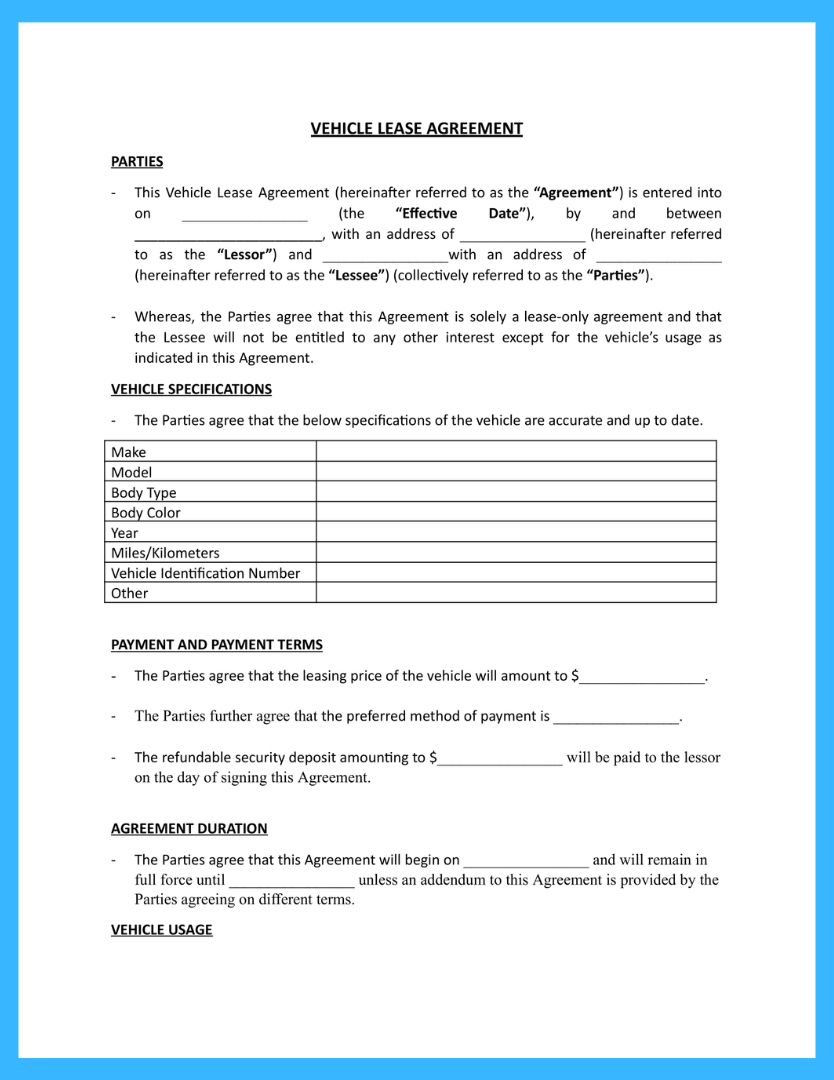
VEHICLE LEASE AGREEMENT
PARTIES
- This Vehicle Lease Agreement (hereinafter referred to as the “Agreement”) is entered into on ________________ (the “Effective Date”), by and between ________________________, with an address of ________________ (hereinafter referred to as the “Lessor”) and ________________with an address of ________________ (hereinafter referred to as the “Lessee”) (collectively referred to as the “Parties”).
- Whereas, the Parties agree that this Agreement is solely a lease-only agreement and that the Lessee will not be entitled to any other interest except for the vehicle’s usage as indicated in this Agreement.
VEHICLE SPECIFICATIONS
- The Parties agree that the below specifications of the vehicle are accurate and up to date.
Make | |
Model | |
Body Type | |
Body Color | |
Year | |
Miles/Kilometers | |
Vehicle Identification Number | |
Other |
PAYMENT AND PAYMENT TERMS
- The Parties agree that the leasing price of the vehicle will amount to $________________.
- The Parties further agree that the preferred method of payment is ________________.
- The refundable security deposit amounting to $________________ will be paid to the lessor on the day of signing this Agreement.
AGREEMENT DURATION
- The Parties agree that this Agreement will begin on ________________ and will remain in full force until ________________ unless an addendum to this Agreement is provided by the Parties agreeing on different terms.
VEHICLE USAGE
- The Parties agree that the usage of the vehicle will only be personal and not for any other purposes.
LATE RETURN
- In case of late return of the vehicle by the Lessee, the Parties agree that an amount of $________________ will be paid to the Lessor for every day that is beyond the end of the lease period.
WARRANTIES AND GUARANTEES
The Lessor warrants the following:
- He/she is fully entitled and authorized to lease the vehicle.
- The vehicle is leased free of any encumbrances, legal claims, court orders and/or liens.
- The vehicle is fully/partially insured.
- The vehicle does not possess any damage requiring repairs amounting to more than $________________.
- The vehicle does not possess any orders for inspection.
- To solely lease the vehicle to approved drivers.
- Not to request the return of the vehicle unreasonably.
The Lessee warrants the following:
- To pay the full costs of fuel.
- Not to take the vehicle out of the region unless a written consent is obtained from the Lessor.
- To return the vehicle upon the conclusion of the leasing period.
- Not to operate the vehicle when and if under the influence of alcohol or any other intoxicating substances.
- To pay the Lessor the leasing amount in full.
- Not to sublease the vehicle.
LIABILITY
- Under no circumstances will the Parties be liable for any indirect, special, consequential, or punitive damages arising out of and/or relevant to this Agreement or the transactions the Agreement contemplates. This is in case such is not related to the direct result of one of the party’s negligence or breach.
DISPUTE RESOLUTION
- Any dispute and/or difference arising out of or related to this Agreement will be submitted to ________________ (Arbitration/mediation/negotiation) according to, and subject to the laws of ________________.
GOVERNING LAW
- This Agreement will be governed by and construed according to the laws of ________________.
ENTIRE AGREEMENT
- This Agreement is complete and with respect to the subject matter herein, supersedes all and any prior agreements, understandings, and conditions, expressed or implied, written or oral, of any nature with respect to the subject matter herein.
- The expressed terms control and supersede any course of performance and/or usage of the trade inconsistent with any of the terms herein.
SEVERABILITY
- In an event where a provision of this Agreement is found to be void and/or unenforceable by a court of competent jurisdiction, then the provisions remaining will continue to be enforced.
SIGNATURE AND DATE
- The Parties hereby agree to the terms and conditions set forth in this Agreement and such is demonstrated throughout their signatures below:
LESSOR | LESSEE _______________________________ |
DATE _______________________________ | DATE _______________________________ |
Download Our Free Car Lease Agreement Template Today
The free car lease agreement template is ready to download in Word or PDF. Fill in the blanks, add the clauses your lease needs and send it for signature.
Download the template, adjust the usage clause if the car is for business and have both parties sign.