
Coaching Agreement Template

How To Use a Coaching Contract (Download our Free Template)
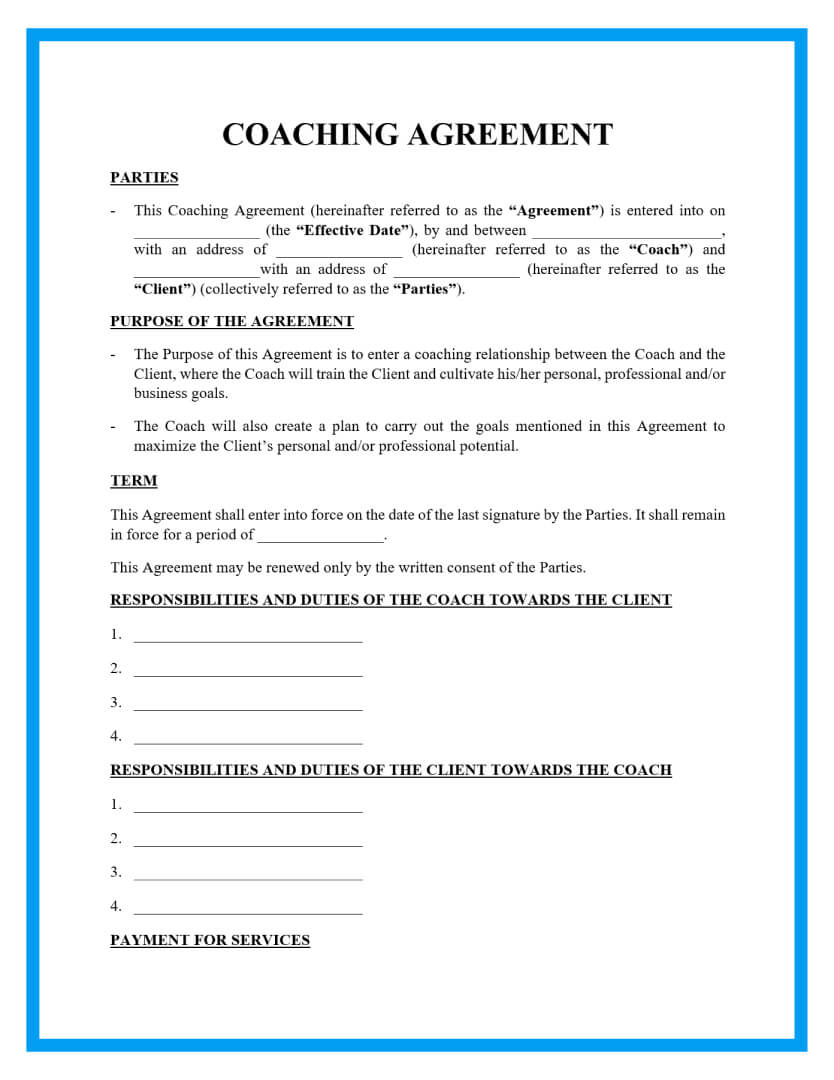
- • Responsibilities and duties
- • Payment terms
- • Exclusivity
What is a coaching contract?
A coaching contract, also called a coaching agreement, is a written agreement between a coach and a client that sets the services, the fees, the schedule and the rules of their working relationship. Once both parties sign it, it is a legally binding agreement, which is why the terms need to be specific.
In short: a coaching agreement states the services, the fee, the cancellation rules, the confidentiality terms and the limit of liability, and both sides sign it before the first paid session.
Regardless of the industry, the coaching contract fundamentally contains the same elements.
DISCLAIMER: We are not lawyers or a law firm and we do not provide legal, business or tax advice. We recommend you consult a lawyer or other appropriate professional before using any templates or agreements from this website.
Get access to our Coaching
Contract Template
Why is a coaching contract agreement important?
- • It shows the client that this isn't your first rodeo, and you mean business. In other words, having a professional agreement gives you credibility.
- • It sets clear expectations of what your coaching fees are, which is motivating for your client to put in the work to get the most value from your coaching.
- • A coaching contract frees up your time to empower your clients, instead of following up on compliance and the fine print of your relationship.
Get access to our Coaching
Contract Template
Five key elements of a coaching contract
1. Responsibilities
2. Confidentiality
3. Cancellation
4. Exclusivity
5. Payment
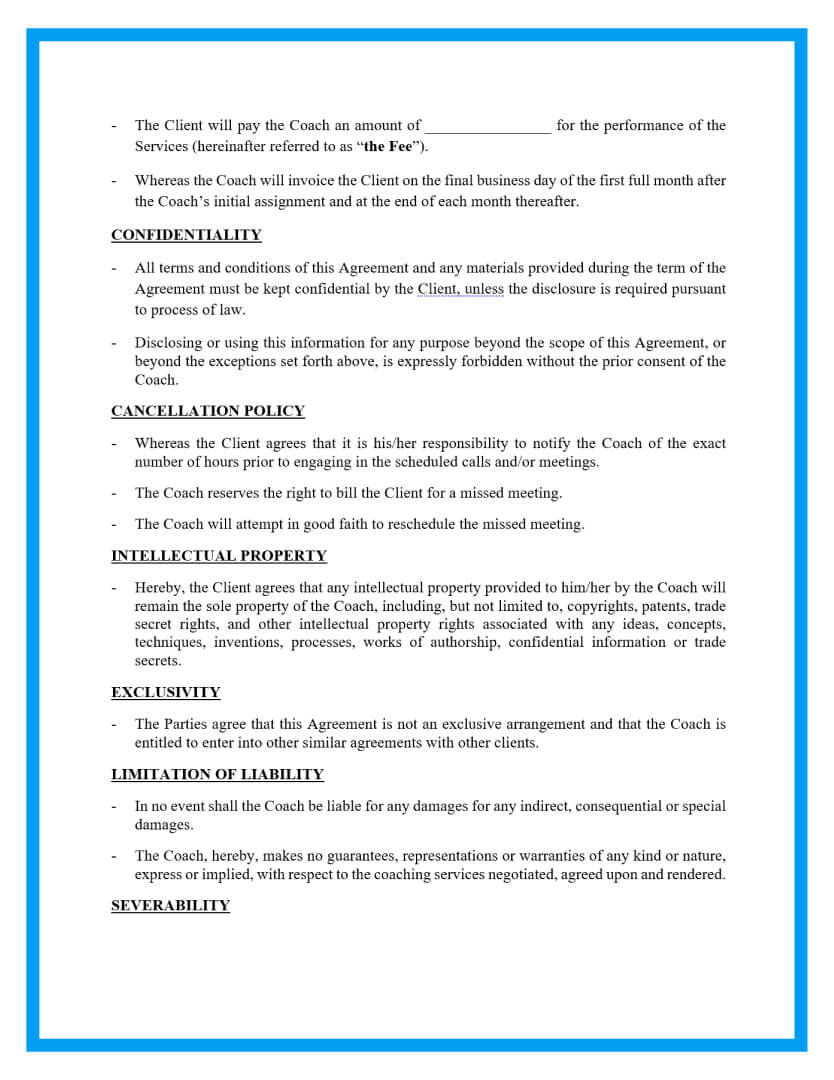
Write down the total fee, when each payment is due and how the client pays. Say whether you require payment upfront or on a schedule, what happens when a payment fails and whether you refund unused sessions. The Payment For Services section of the template has a blank for the fee and a monthly invoicing clause.
What to Include in a Coaching Agreement
A coaching agreement should name the parties, describe the services and the length of the program, set the fees and cancellation rules, protect confidentiality, say who owns the materials, state that coaching is not therapy, limit liability and end with signatures from both sides. The five elements above cover the core. The checklist below adds the clauses that coaches most often leave out.
Scope of services and what coaching is not
Describe the program in concrete terms: the number of sessions, the length of each session, the format (video call, phone or in person) and the end date. Then state that coaching is not therapy, counseling, medical advice or legal advice and that the client will turn to a qualified professional for those needs. The Purpose of the Agreement section of the template holds the first part. Add the second as a short sentence there.
Fees, refunds and pauses
Write the total fee, the payment schedule and your refund stance in the Payment For Services section. If your policy is no refunds once the program starts, say so in writing. Add a pause rule too: how long a client may pause, what makes a request valid and whether unused sessions carry over or expire. The template has no refund or pause clause, so add one if your program needs it.
Ownership of materials
Say who owns the worksheets, frameworks and session recordings. A typical approach is that the coach keeps ownership and the client may use the materials for their own purposes but not resell or rebrand them. The Intellectual Property section of the template keeps the coach’s materials the coach’s property. If you record sessions, add who owns the recording and how long you keep it.
Liability and insurance
The Limitation of Liability section says the coach is not liable for indirect, consequential or special damages and makes no guarantee of results. Do not promise a specific outcome in the agreement or in your marketing. Consider professional liability insurance as well: the U.S. Small Business Administration describes it as coverage for businesses that provide services to customers against financial loss from malpractice, errors and negligence (SBA).
Termination and governing law
State how either side can end the engagement, how much notice is required and what happens to prepaid sessions. The template has a Term section but no separate termination clause, so add one if you want the right to end the engagement early. Fill in the state whose law applies in the Governing Law section and choose arbitration, mediation or negotiation in the Alternative Dispute Resolution section.
Coaching Agreement vs Letter of Engagement
Use a full coaching agreement for a program that runs for several months, carries a larger fee or has several parts, and a letter of engagement for a single session or a short, clearly limited engagement. A letter of engagement is a shorter document that confirms the scope, the dates and the price. It is still a written agreement, but it skips most of the clauses above. When in doubt, use the full agreement.
Red flags in a coaching agreement
Avoid these clauses, whether you write the agreement or sign it as a client:
- Guaranteed outcomes: coaching is a joint process, so a promise such as a set income or a job offer invites a dispute.
- No way to end the engagement: an agreement that one side cannot leave is one sided.
- Confidentiality without exceptions: you cannot promise to ignore a court order or a credible safety risk.
- Terms one side can change alone: changes to fees or scope should need the written consent of both parties, as the Amendments section of the template requires.
- Vague services: the word coaching alone does not tell the client what they are paying for.
- Hidden auto renewal: the template renews only by the written consent of both parties.
How to Fill Out, Edit and Sign the Coaching Agreement Template
Download the template as a Word file to edit on screen or as a PDF to print and complete by hand, fill in every blank, adapt the services and the fee to your program and have both parties sign. Follow these steps to complete it.
- Download the free coaching agreement template as a Word file or a printable PDF.
- Enter the Effective Date and the names and addresses of the coach and the client in the Parties section.
- Describe the program in the Purpose of the Agreement section and list the duties of the coach and of the client in the two numbered lists.
- Enter the fee in the Payment For Services section, then set the term, the cancellation notice in hours and the governing law.
- Add the clauses your program needs, such as a pause policy, a refund rule and a termination right, and delete what does not apply.
- Have a lawyer in your state review the agreement if you change it a lot.
- Send the agreement to the client to sign before the first paid session, then sign your part and keep a copy.
You can collect the signatures on paper or electronically. A signature or contract may not be denied legal effect, validity or enforceability solely because it is in electronic form under 15 U.S.C. 7001, and an e-signature tool like Signaturely lets the client sign from any device while you track the request. Our guide to e-signature legality explains what to check.
Check before you send the agreement: the names and addresses, the program and its end date, the fee and the payment dates, the cancellation notice, the governing law, any clauses you added and the signature lines for both parties.
Adapting the template to your type of coaching
Life, executive, business, career, health and group coaching need the same core clauses. Change the program description and the duties for your niche, add a consent clause if you want to use client results in your marketing and, for group programs, add a rule on what participants may share outside the group. If you also take on advisory work, our consulting agreement template covers that side.
Coaching Agreement Questions
What should be in a coaching contract?
A coaching contract should state the parties, the services and the program length, the fee and payment terms, the cancellation policy, confidentiality, ownership of materials, a limit of liability, the governing law and the signatures of both sides. The sections above explain each part.
Is a coaching agreement legally binding?
A coaching agreement is legally binding once both parties sign it and each side gives something of value, such as coaching in return for a fee. Rules differ by state, so have a lawyer check any larger changes to the template.
Can a coaching agreement be signed electronically?
A coaching agreement can be signed electronically. Under 15 U.S.C. 7001 a contract may not be denied legal effect, validity or enforceability solely because an electronic signature was used in its formation.
Is there a difference between a coaching agreement and a coaching contract?
A coaching agreement and a coaching contract mean the same thing for most coaches, because the terms and the signatures of both parties matter more than the name.
FAQ about our Coaching Contracts
A contract protects you against those nasty situations and gives you a formal document for you and your client to be accountable to.
So although you don’t technically need a coaching contract, it’s a good idea to have one.
Just be mindful that if you make any drastic changes, it might be worth getting a lawyer to look over it.
It’s also at this point; you can include a copy of your contract agreement as a formal document to convert your prospect into a paying client.
Introducing a contract also acts as a tool for uncovering any objections your client might have about your offerings.
Coaching Agreement
Coaching Agreement
Parties
Purpose Of The Agreement
Term
Responsibilities And Duties Of The Coach Towards The Client
- ______________________
- ______________________
- ______________________
- ______________________
Responsibilities And Duties Of The Client Towards The Coach
- ______________________
- ______________________
- ______________________
- ______________________