
Accounting Contract Template
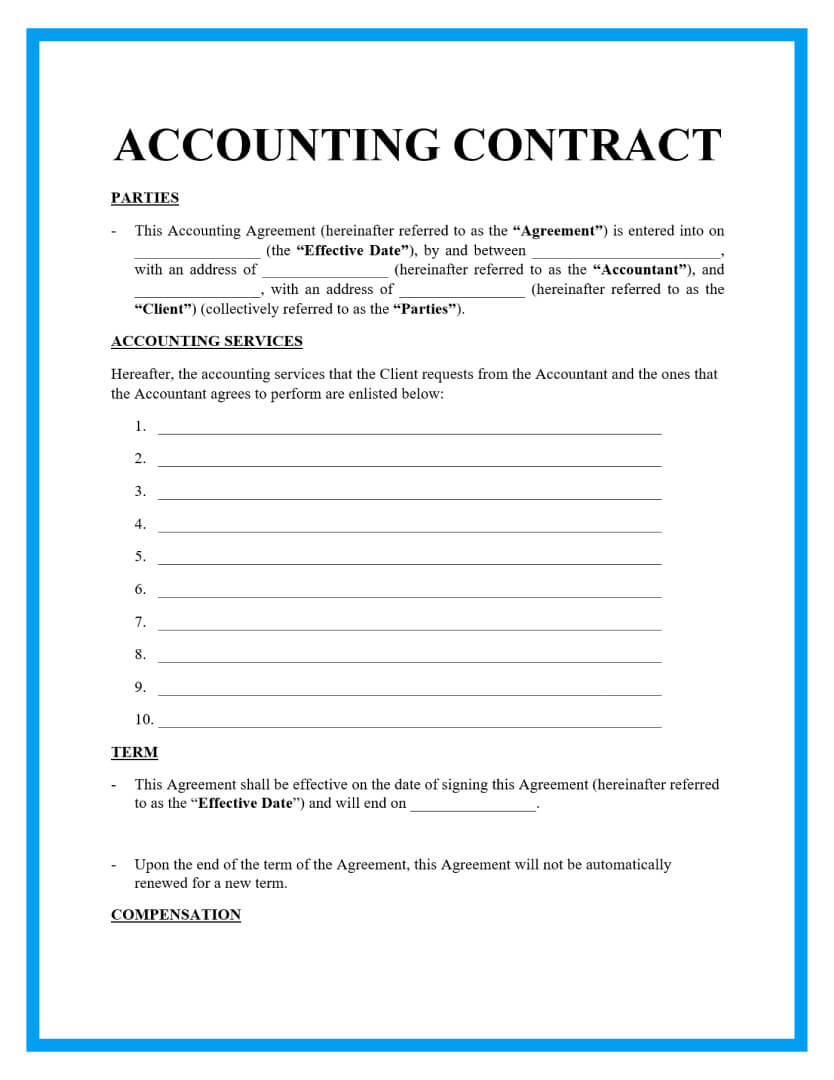


Free Accounting Contract Template for Download
- • List of services
- • Contract length
- • Confidentiality terms
What is an accounting contract?
An accounting contract is a written agreement between an accountant and a client that sets out the services, fees, timeline and confidentiality terms for the work. It’s also called an accounting services agreement, and it fits bookkeeping, payroll and tax preparation engagements. Accountants use it with each new client, and a business owner hiring an accountant can ask for one to put the scope and price in writing.
DISCLAIMER: We are not lawyers or a law firm and we do not provide legal, business or tax advice. We recommend you consult a lawyer or other appropriate professional before using any templates or agreements from this website.
Get access to our Accounting
Contract Template Sample
Why an accounting contract agreement is important for accountants
An accounting agreement offers protection for clients and accountants when it comes to financial compliance and advice. A formal contract aims to hold all parties accountable to maintain accurate and up to date financial records.
Best practices when using an accounting contract
1. Be specific with your offerings
- • Are you the sole owner of your investment property?
- • Does your business have payroll?
- • What type of business entity do you have?
- • Have you worked with an accountant before? If so, what was the experience like?
- • Are your taxes up to date?
- • How does your business make money?
- • Have you sold any investments in the last year?
- • Do you use accounting software? If so, what do you use?
2. Determine the length of your accounting contract
3. Set expectations for how you want to be paid
We also recommend a late fee for overdue invoices, written into the contract terms. A late fee reduces late payments and improves your cash flow, and our template leaves the amount blank so you can set it yourself.
What should an accounting contract include?
An accounting contract should name both parties, list the services, set the fees and payment dates, state the term, protect confidential information and explain how either side can end the agreement. Our template covers each of these in 17 short sections, so you only fill in the blanks.
- Parties and services: the accountant, the client and up to ten numbered service lines.
- Term: the agreement starts on signing and ends on a date you choose, with no automatic renewal.
- Compensation: an hourly rate invoiced monthly, plus a late fee if an invoice stays unpaid for thirty days.
- Work ownership and relationship: the client owns the reports and documents you create, and you work as an independent contractor, not an employee.
- Confidentiality and audit: you keep the client’s information private, also for a set number of years after the agreement ends, and maintain full records for inspection.
- Representations and liability: you follow the ethics standards of the International Ethics Standards Board for Accountants, and the contract limits liability for indirect and punitive damages.
- Termination: either side can end the agreement immediately after a breach or by written notice, and you return the client’s materials within thirty days.
- Dispute resolution, governing law and amendments: how disagreements get settled, which law applies and how changes get signed.
The audit section leaves the record keeping period to whatever the law requires. For tax returns, a federal rule requires a signing tax return preparer to keep a copy or record of each return for three years after the close of the return period in which it was presented to the client for signature (26 CFR 1.6107-1). Other services can carry different retention rules, so check the ones that apply to your work.
The template doesn’t include a clause on client duties, such as delivering bank statements and records on time. If you want one, add it to the Word file before signing and have a lawyer review the wording. For stricter confidentiality terms, pair the contract with our non-disclosure agreement template.
Which services and fee model should you put in the contract?
List every service you’ll provide, such as bookkeeping, payroll, tax preparation or financial statements, and choose between an hourly rate, a monthly retainer and a fixed project fee before you send the contract. Write each service as one line with its frequency and deliverable, for example “Monthly bank and credit card reconciliation” or “Annual business tax return preparation,” so nothing is left to assumption. The three fee models fit different kinds of work.
- Hourly rate: you bill the hours worked each month. Our template uses this model, and it suits work that changes from month to month.
- Monthly retainer: the client pays a set amount each month for a defined list of recurring services, which suits ongoing bookkeeping.
- Fixed project fee: one price for a one-off job, such as a cleanup of old books or a year-end filing.
If you prefer a retainer or a fixed fee, edit the Compensation section in the Word file and have a lawyer check the change. Work the client adds later belongs in a written amendment signed by both parties, which the template requires for every change. For a bookkeeping-only engagement, see our book-keeping contract agreement template.
How do you fill out and sign an accounting contract?
To fill out the accounting contract template, download the Word or PDF file, complete the blank lines and review the terms with your client before anyone signs. Use the Word file to type your details, or print the PDF as a blank copy and write them in by hand.
- Enter the effective date and the names and addresses of the accountant and the client.
- List the services on the numbered lines.
- Set the end date, the hourly rate, the late fee and the number of days’ notice for termination.
- Enter how many years the confidentiality duty lasts after the agreement ends.
- Choose the dispute resolution method and the governing law.
- Go through the finished contract with your client, then both of you sign and date it.
Signing comes last, and both parties should sign and date the contract before work starts. You can sign on paper or electronically. Under the federal ESIGN Act, a signature or contract for a transaction in interstate or foreign commerce can’t be denied legal effect solely because it’s in electronic form (15 U.S.C. 7001). Our guide to electronic signature legality explains when that applies, and you can upload the finished contract to Signaturely to send it to your client for signature. Keep a signed copy for each party, and have a lawyer review the contract if the engagement is complex or you change the clauses.
Get access to our Accounting
Contract Template Forms
FAQ about Accounting Contracts
Using an accounting engagement letter is common practice in the industry when liaising with new clients.
An accounting contract conversely, is a formal agreement that requires a signature from both the accountant and client.
Accountants use a combination of a letter and a contract depending on what they’re used to doing.
We recommend you use both when engaging with new clients, as the letter is a simple document to interpret while the contract provides legal proof of the commitments each party has made.
A contract protects you against those situations and gives you a reference document to be accountable to.
So while it’s not a requirement to have an accounting contract, it’s a good idea to have one.
However, if you intend to make significant modifications, we advise you to consult with a lawyer for compliance.
Accounting Contract
Accounting Contract
Parties
Accounting Services
- _______________________________________
- _______________________________________
- _______________________________________
- _______________________________________
- _______________________________________
- _______________________________________
- _______________________________________
- _______________________________________
- _______________________________________
- _______________________________________
Term
Compensation
Work Ownership
Relationship Between Parties
Confidentiality
Audit
Representation And Warranties
Limitation Of Liability
Termination
- Immediately in case one of the Parties breaches this Agreement.
- At any given time by providing a written notice to the other party ______________ days prior to terminating the Agreement.