
Catering Agreement Template
Tedious paperwork shouldn’t slow down a catering business with this many moving parts. This free catering agreement template (PDF and Word) covers the event, the services, payment, cancellation and signatures, so you can book a client with a clear contract and spend your time on the food.

Free Catering Agreement Template
Choose the Word version to edit the text on screen or the PDF to print a clean copy. Both files hold the same sections, so you never have to draft a catering agreement from scratch.
- • List of services provided
- • Event dates
- • Payment terms
What is a catering contract?
A catering contract is a written agreement between a caterer and a client that fixes the services, the event details, the price and what happens if plans change. Caterers provide food, drinks and hospitality services at events ranging from business functions to weddings and everything in between.
A good contract covers the menu and services, the event date and venue, the guest count, the price, the deposit and the cancellation terms. It gives the caterer a way to charge clients for food and beverage services and protects the booking when plans change. A catering proposal presents the menu and price you offer, while the contract is the signed document that commits both sides to them, so send a catering proposal first and the contract once the client agrees.
The agreement sets the terms and conditions for the work the caterer carries out at the event.
DISCLAIMER: We are not lawyers or a law firm and we do not provide legal, business or tax advice. We recommend you consult a lawyer or other appropriate professional before using any templates or agreements from this website.
Download our Catering
Contracts Today
Open the Word file to adapt the services, the date and the fees to each event, or print the PDF and fill it in by hand.
Why is a catering contract important for caterers?
Catering and event planning are time-sensitive businesses that depend on suppliers, contractors and employees to carry out the client’s vision. That means a lot of planning and collaboration with third parties to make an event a success.
A catering contract helps caterers get paid on time so they can cover the expenses of the event.
An agreement also holds both sides accountable for delivering a great experience for guests.
Without a catering contract, payments can be missed, deadlines may not be met and clients can walk away disappointed with the experience.
What to Include in a Catering Contract
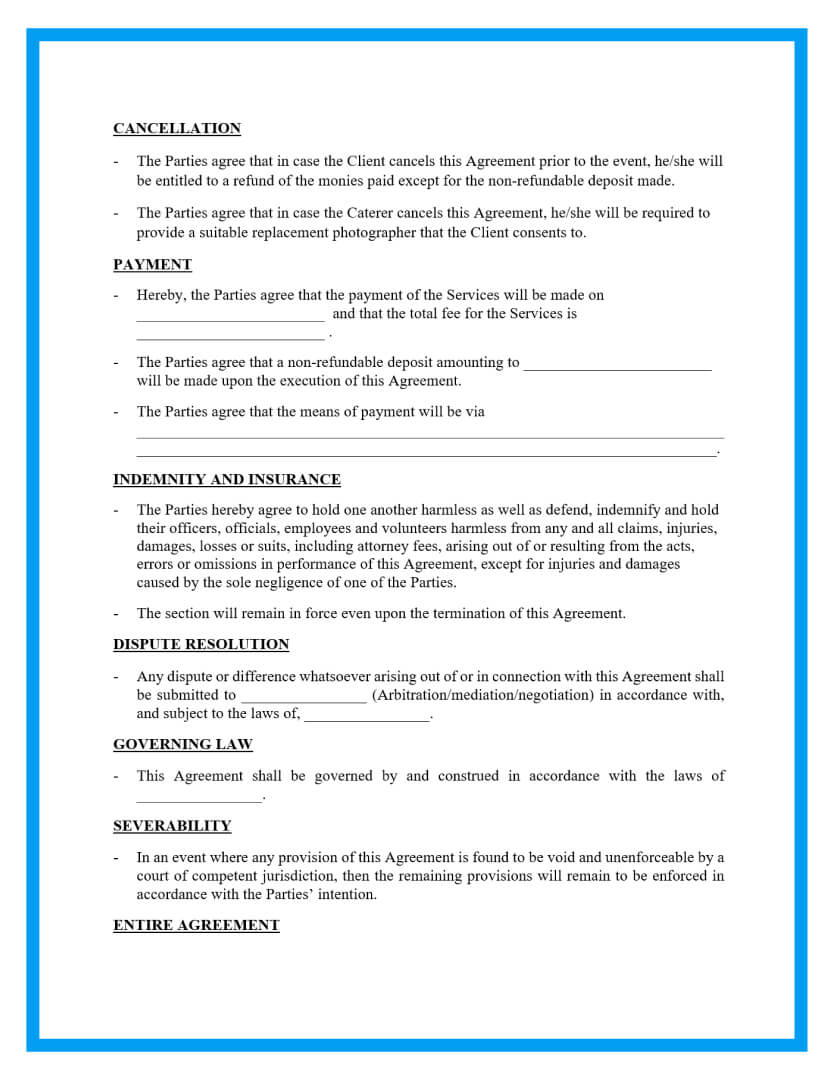
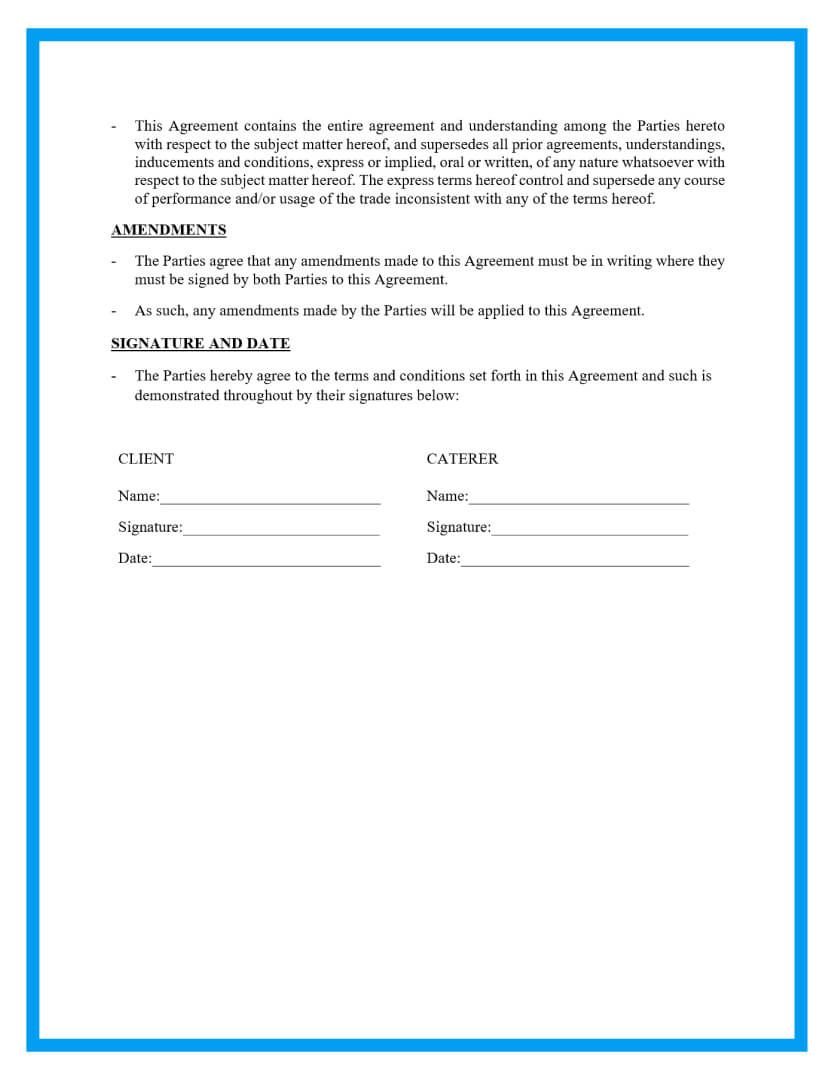
A catering contract should name the event, the guest count, the menu and services, the price, the deposit and the cancellation terms. The template on this page has sections for the parties, services, event date, contact information, cancellation, payment, indemnity and insurance, dispute resolution and signatures. Add the points below when your event calls for them.
Check before you send the contract: the guest count and the date the final count is due, the deposit and the balance due date, the cancellation fee at each stage, how allergies are disclosed, and who holds the alcohol permit and carries the insurance.
Guest count and guaranteed headcount
A guaranteed headcount is the minimum number of guests the client always pays for, whatever the turnout. The caterer buys food, books staff and rents equipment around that number, so the contract should state it, set a date by which the client confirms the final count and say how guests above the guarantee are billed. The template has no separate guest count field, so list the number under Services Provided.
Deposit and payment schedule
State the total price, the deposit that holds the date, the date the balance is due and the payment methods you accept. Say whether the deposit is refundable and what happens when a payment is late. The Payment section of the template has blanks for the payment date, the total fee, the non-refundable deposit and the means of payment.
Cancellation, postponement and force majeure
Tie the cancellation terms to timing, because a client who cancels months ahead costs the caterer less than one who cancels in the week of the event, when the food is ordered and the staff are booked. Set the refund or fee for each stage and keep the deposit non-refundable. The template gives a client who cancels a refund of the money paid except the non-refundable deposit. Add a line on postponement, which moves the date instead of ending the booking, and a force majeure clause for events neither side controls, such as severe weather or a venue closure.
Menu, allergies and food safety
Put the menu in the contract or attach it, and say how substitutions are handled when an ingredient is not available. Ask the client to disclose guest allergies in writing. The FDA lists nine major food allergens: milk, eggs, fish, crustacean shellfish, tree nuts, peanuts, wheat, soybeans and sesame (FDA). Oversight of restaurants and retail food is typically handled at the state and local level rather than the federal level (FDA), so check which permits your state and county require for catering.
Alcohol and insurance
If you serve alcohol, confirm who holds the license or permit for the event and whether the venue allows outside bartenders, because the rules differ by state and venue. Say which insurance the caterer carries and whether the venue wants proof of coverage. The template includes an Indemnity and Insurance section in which the parties agree to hold one another harmless.
Attachments to the contract
Attach the documents the contract refers to: the menu, the beverage list, the rental list and an itemized invoice that includes staffing. Ask the client to initial each attachment so nobody can dispute what was agreed.
What red flags should you look for in a catering contract?
Be especially careful with a contract that has no stated price or deposit, no cancellation terms, no headcount rule, no mention of insurance or permits or no signature block for both sides. Vague wording on what the price includes, such as staff, rentals or service charges, is an easy way for a dispute to start. If you also plan the event, our event planning contract template covers the planner’s side of the booking.
How to Fill Out, Edit and Sign the Catering Agreement Template
Download the template as a Word file to edit on screen or as a PDF to print and complete by hand, fill in every blank, attach the menu and invoice, and have both parties sign. The steps are:
- Download the free catering agreement template as a Word file or a printable PDF.
- Fill in the parties, the services, the event date, the start and end times, the location and the contact details.
- Enter the total fee, the non-refundable deposit, the balance due date and the means of payment.
- Review the cancellation, indemnity and insurance sections and adjust them to your event.
- Attach the menu, the beverage list, the rental list and the itemized invoice.
- Send the contract to the client to sign, then sign the caterer section once the deposit has arrived.
- Give each party a signed copy and keep it with the event file.
You can sign on paper or electronically. A signature or contract cannot be denied legal effect solely because it is in electronic form under 15 U.S.C. 7001, and our guide to e-signature legality explains what to check. Use Signaturely to collect e-signatures and send the contract by email.
How to use a catering agreement to get more clients
A standard catering contract is a powerful document that can grow your income, even though that may not seem obvious. Below are three examples of how you can get the most out of your template.
1. Improve your customer intake system
- 1. Respond to inquiry
- 2. Book a consultation
- 3. Conduct client consultation
- 4. Send proposal
- 5. Send receipt
- 6. Start project
Let’s go back to step four. After the client consultation, it’s common practice to send a proposal that shows how you will deliver the catering service at the event.
By presenting both a catering proposal and contract, your potential clients will have all of the information they need to learn about how you work, and if they’re comfortable, they sign your contract to lock in their selection.
2. Managing cash flow and projections
- 1. Contracts
- 2. Pending contracts
If your customer chose to go with another caterer, see if you can find out why so you can improve your proposals and offerings.
3. Payment terms and cancellations
Cancellations decide how much of your income is safe. Clients change their minds for all kinds of reasons, and some will want to end the contract before the event date.
The more cancellations you have, the more income you lose. You miss out on the client’s fees and you can’t get back the time you spent talking to suppliers, planning meals and handling other admin.
Use your contract to set a non-refundable deposit and cancellation fees that rise as the event gets closer. When a client signs off on those clauses up front, you keep part of the lost income and fewer events get canceled. Put the balance due date in the same clause so payment is settled before the day of the event. A payment agreement template can help you lay out an installment schedule for larger events.
Download our Catering Contract Today
A signed contract turns a prospect into a booked event and protects your income when plans change. Get your copy of the catering contract agreement below.
FAQ about our Catering Contract Templates
Catering Agreement
Catering Agreement
Parties
Services Provided
- ______________________
- ______________________
- ______________________
- ______________________
- ______________________
- ______________________
- ______________________
- ______________________
Event Date
Contact Information
Cancellation
Payment
Indemnity And Insurance
Dispute Resolution
Governing Law
Severability
Entire Agreement
Amendments
Signature And Date
Related Proposals and Templates
Download our Catering Agreement Contract Today
Before you send the contract, attach your menu and invoice, check the cancellation terms and decide who signs first.